
Qi-Moving Herbs
Chen Pi (Tangerine Peel)
Name
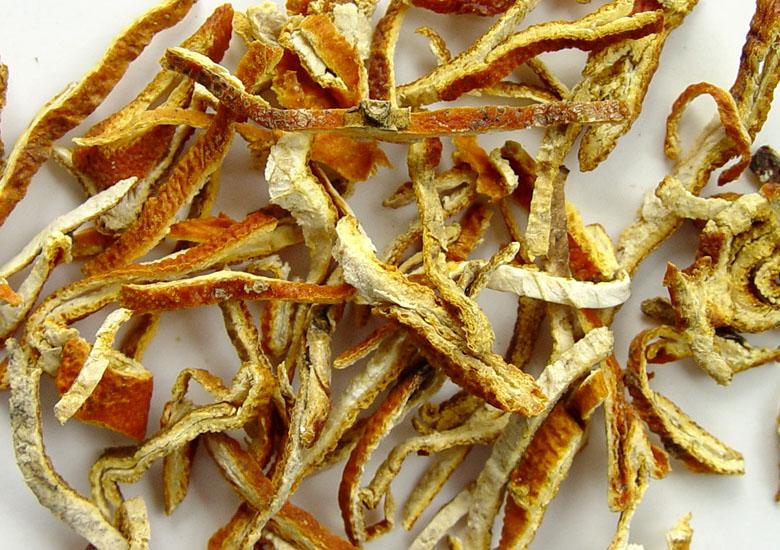
Chen Pi (Pericarpium Citri Reticulatae), recorded in the Shennong Bencao Jing.
Source and quality
Plant
The pericarp of the evergreen small tree Citrus reticulata Blanco, family Rutaceae.
Where it is grown
Guangdong, Fujian and Sichuan provinces.
Harvest
Collected in autumn once the fruit has ripened.
Smell and taste
Strongly fragrant, acrid and slightly bitter.
Better grade
Large and intact, with a deep-red outer skin and white inner flesh; plenty of flesh, heavy and oily, with a dense, fragrant aroma and a pungent taste.
Processing
Used unprocessed.
Nature and action
Acrid, bitter and warm; enters the spleen and lung channels. Promotes the flow of qi, arrests vomiting, dries dampness and resolves phlegm.
When it is used
Qi stagnation in the spleen and stomach
Chen Pi is good at moving spleen and stomach qi, and its action is gentle. It is used for qi stagnation in the spleen and stomach. Because it also checks adverse rise of qi to arrest vomiting, dries dampness and invigorates the spleen, it suits nausea and vomiting from qi stagnation in the spleen and stomach, especially where dampness and qi stagnation combine.
For distension, stuffiness, fullness and pain in the stomach and abdomen from qi stagnation, it is used alone or with herbs that move qi and harmonize the middle burner, such as Mu Xiang in Kuan Zhong Wan from Ji Feng Pu Ji Fang. For distension, nausea, vomiting and diarrhea from damp accumulation and qi stagnation in the middle burner, it is often combined with herbs that resolve dampness and move qi, such as Cang Zhu and Hou Po in Ping Wei San from Taiping Huimin Heji Jufang.
For distending pain in the stomach and abdomen and poor appetite from food stagnation, it is combined with digestants, such as Shan Zha and Shen Qu in Bao He Wan from Dan Xi Xin Fa. For spleen deficiency with qi stagnation, with distension, abdominal pain that prefers pressure, poor appetite or fullness after meals, and loose stool, it is combined with herbs that tonify qi and invigorate the spleen, such as Dang Shen, Bai Zhu and Fu Ling in Yi Gong San from Xiao Er Yao Zheng Zhi Jue.
Vomiting and hiccup
It not only moves qi but also checks adverse rise of qi and harmonizes the stomach to arrest vomiting, so it is combined with other herbs for vomiting and hiccup.
For nausea and vomiting from qi stagnation in the middle burner with failure of stomach qi to descend, it is often combined with herbs that harmonize the stomach and stop vomiting, such as Sheng Jiang in Ju Pi Tang from Jingui Yaolue. For nausea and vomiting from damp-phlegm accumulation with qi stagnation and failure of stomach qi to descend, it is combined with Ban Xia to dry dampness, resolve phlegm, check adverse rise of qi and arrest vomiting. For vomiting and diarrhea from invasion by wind and cold or by dampness, it is combined with herbs that disperse wind-cold, harmonize the stomach and stop vomiting, such as Huo Xiang and Zi Su in Huo Xiang Zheng Qi San from Taiping Huimin Heji Jufang. For vomiting from cold in the stomach it is combined with Sheng Jiang, as in Jiang Ju Tang from Huo You Xin Shu.
Cough from damp-phlegm or cold-phlegm
It dries dampness and resolves phlegm, and disperses and directs lung qi downward, so it is used for cough from damp-phlegm or cold-phlegm.
For cough with copious sputum, fullness of the chest, nausea and vomiting from damp-phlegm accumulation, it is often combined with herbs that dry dampness and resolve phlegm, such as Ban Xia in Er Chen Tang from Taiping Huimin Heji Jufang. For cough from cold-phlegm with copious, clear sputum, fullness of the chest and profuse saliva, it is combined with herbs that warm the lung and resolve phlegm, such as Gan Jiang and Gan Cao in Si Shun San from Sheng Ji Zong Lu.
Separately, it can be used in tonic formulas to strengthen the spleen's transporting and transforming function.
Dose
Decoction 3~10 g.
Sources and further reading
We cite classical materia medica and modern reference works. This article is health education, not medical advice.
- Shennong Bencao Jing (The Divine Farmer's Materia Medica), Han dynasty.
- Bencao Gangmu (Compendium of Materia Medica), Li Shizhen, 1578.
- Chinese Pharmacopoeia, current edition — identity, quality and safety monographs.
- NCCIH and WHO reference material on traditional medicine safety.
Spotted an error or a better source? Tell us — corrections are logged on our editorial policy page.
Did this article help you?
Your answer shapes what gets rewritten next.
Keep readingRelated entries
Ju Pi (Tangerine Peel) in TCM
Name Chen Pi (Pericarpium Citri Reticulatae) — Shennong Bencao Jing Source and quality Plant The pericarp of evergreen small arbor Citrus reticulata Blanco of family Rutaceae.
 Ma Lu: Chinese Herb Guide
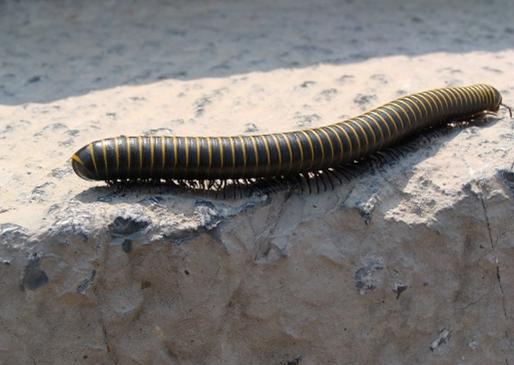
Ma Lu (Diplopod) Acrid, warm, toxic; heart and lung channels. Actions Eliminate mass and fullness, remove toxicity
Chen Pi (Pericarpium Citri Reticulatae)
Tangerine Peel: promote flow of qi, arrest vomiting, dry dampness and resolve phlegm.
 Jin Ju Ye (Leaf of Oval Kumquat)
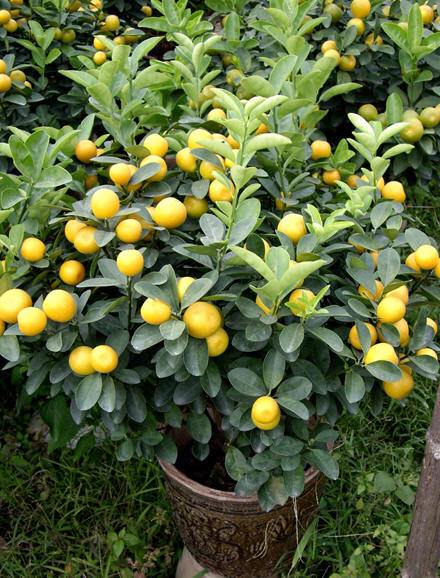
Jin Ju Ye: soothe the liver, relieve depression, regulate the flow of qi and dissipate nodule.
Something this article did not cover?
Ask us directly. We reply within two days, and good questions become public articles.
Ask a question →