
Damp-Resolving Herbs
Hou Po (Officinal Magnolia Bark)
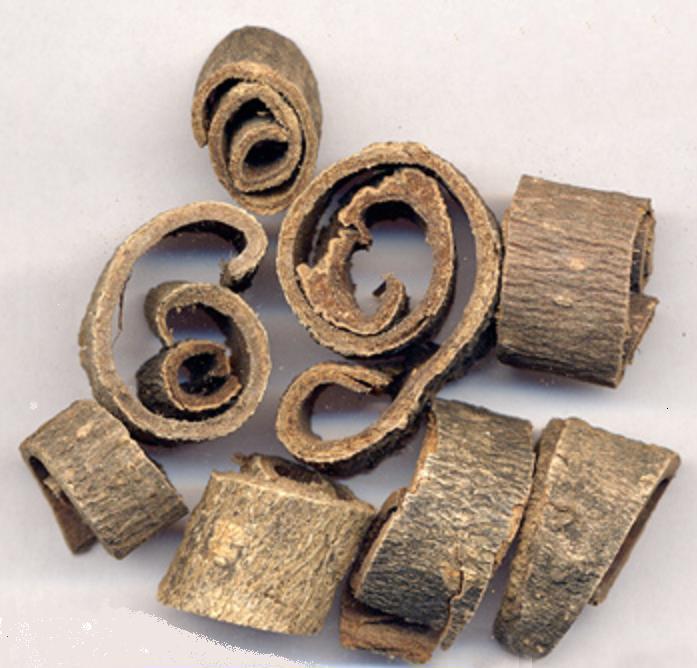
Name
Hou Po (Cortex Magnoliae Officinalis), recorded in the Shennong Bencao Jing (Shennong's Herbal)
Source and quality
Origin
The dried bark, or the bark of the branch or root, of Magnolia officinalis Rehd. et Wils. or M. officinalis Rehd. et Wils. var. biloba Rehd. et Wils., family Magnoliaceae.
Where it is grown
Sichuan and Hubei provinces, and elsewhere in China.
Harvest
Collected from April to June.
Smell and taste
Fragrant, acrid and slightly bitter.
Better grade
Thick bark with a smooth surface, heavy and oily, purple-brown in the endothecium, with a lustrous crystalline surface and a strong fragrance.
Processing
Cut into pieces and prepared with ginger juice.
Nature and action
Bitter, acrid and warm; enters the Spleen, Stomach, Lung and large intestine channels. Dries dampness, moves qi and relieves dyspnea.
When it is used
Damp obstruction of the middle jiao
Hou Po is bitter and acrid: it not only dries damp turbidity but also moves qi and relieves distention. Where damp obstructs the middle jiao and qi movement is disturbed, with gastric and abdominal distention, poor appetite, nausea and vomiting, it is usually combined with herbs that dry dampness and move qi, such as Cang Zhu and Chen Pi in Ping Wei San from Tai Ping Hui Min He Ji Ju Fang.
Qi stagnation of the Stomach and intestines
Hou Po is fragrant, and is the essential herb for moving qi and relieving distention.
For constipation with gastric and abdominal distending pain due to heat retention, it is combined with purgative and heat-clearing herbs, such as Da Huang and Mang Xiao in Da Cheng Qi Tang from Shang Han Lun.
Where food stagnation disturbs qi movement, with gastric and abdominal distending pain, belching and acid regurgitation, it is combined with digestants, such as Zhi Shi and Mai Ya in Zhi Shi Xiao Pi Wan from Lan Shi Mi Cang.
Dyspnea and cough from adverse rise of qi
Hou Po dries dampness, resolves phlegm, drives qi downward and relieves dyspnea. Where phlegm and dampness obstruct the interior so that lung qi rises adversely, with cough, dyspnea and chest stuffiness, it is combined with herbs that dry dampness, resolve phlegm, drive qi downward and relieve dyspnea, such as Zi Su Zi, Chen Pi and Ban Xia in Su Zi Jiang Qi Tang from Tai Ping Hui Min He Ji Ju Fang.
For chest stuffiness, dyspnea and wheezing due to phlegm retained in the throat, with restlessness caused by cold fluid transforming into heat, it is combined with herbs that clear the lung and relieve dyspnea, such as Ma Huang, Shi Gao and Xing Ren in Hou Po Ma Huang Tang from Jin Gui Yao Lue.
For dyspnea and cough brought on by renewed invasion of wind-cold, it is combined with herbs that induce sweating to release the exterior and open the lung to relieve dyspnea, such as Gui Zhi and Xing Ren in Gui Zhi Jia Hou Po Xing Zi Tang from Shang Han Lun.
Plum-stone syndrome
Its actions of drying dampness, resolving phlegm, driving qi downward and soothing the middle jiao also apply to plum-stone syndrome, where phlegm and qi combine. It is combined with herbs that resolve phlegm and move qi, such as Ban Xia, Fu Ling, Zi Su and Sheng Jiang in Ban Xia Hou Po Tang from Jin Gui Yao Lue.
Dose
Decoct 3~10 g, or grind into powder for use in pills and powder.
Cautions
Use with caution in patterns of qi deficiency with fluid consumption, and in pregnancy.
Sources and further reading
We cite classical materia medica and modern reference works. This article is health education, not medical advice.
- Shennong Bencao Jing (The Divine Farmer's Materia Medica), Han dynasty.
- Bencao Gangmu (Compendium of Materia Medica), Li Shizhen, 1578.
- Chinese Pharmacopoeia, current edition — identity, quality and safety monographs.
- NCCIH and WHO reference material on traditional medicine safety.
Spotted an error or a better source? Tell us — corrections are logged on our editorial policy page.
Did this article help you?
Your answer shapes what gets rewritten next.
Keep readingRelated entries
Hou Po: Chinese Herb Guide
Dry dampness, move qi, relieve dyspnea. Bitter, pungent, warm; spleen, stomach, lung and large intestine meridians entered.
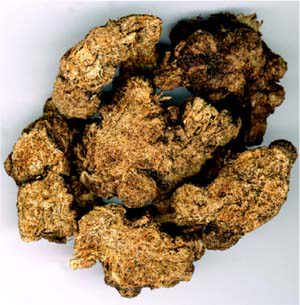 Cang Zhu (Swordlike Atractylodes Rhizome)
: dry dampness and invigorate spleen, dispel wind-dampness, release exterior.
Cang Zhu (Swordlike Atractylodes Rhizome)
Cang Zhu (Swordlike Atractylodes Rhizome): dry dampness and invigorate spleen, dispel wind-dampness, release exterior.
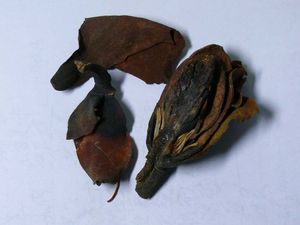 Hou Po Hua (Flower of Official Magnolia)
 Acrid, slightly bitter, warm; spleen, stomach and lung channels. Actions Regulate qi and resolve dampness
Hou Po Hua (Official Magnolia Flower)
Hou Po Hua, the flower of the official magnolia, moves qi and resolves dampness.
Hou Po Hua (Flower of Official Magnolia)
Hou Po Hua (Flower of Official Magnolia) Acrid, slightly bitter, warm; spleen, stomach and lung channels. Actions Regulate qi and resolve dampness
Hou Po Hua (Official Magnolia Flower)
Hou Po Hua, the flower of the official magnolia, moves qi and resolves dampness.
Something this article did not cover?
Ask us directly. We reply within two days, and good questions become public articles.
Ask a question →