
Wind-Damp-Dispelling and Pain-Alleviating Herbs
Fang Ji (Fourstamen Stephania Root)
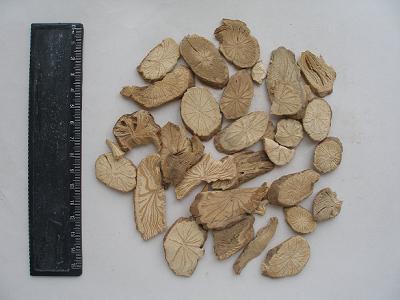
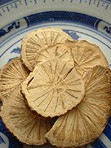
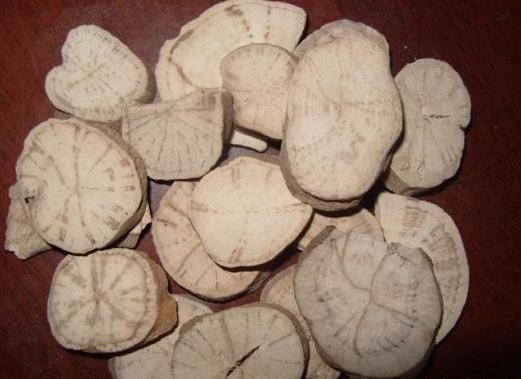
Naming
Fang Ji (Radix Stephaniae Tetrandrae)——Shen Nong Ben Cao Jing (Shen Nong’s Herbal)
The Processing of 防己
Origin
The root of Stephania tetrandra S. Moore of family Menispermaceae.
Location
Anhui, Zhejiang and Jiangxi provinces, etc.
Harvest
Collected in autumn.
The actual smell and taste
Light smell and btter taste.
Best quality
Big root marked by even thickness, solid quality and enough mealiness.
Processing
Dried in sunlight, cut into thick pieces, and unprocessed.
The Effect of 防己
Property
Bitter, pungent, cold; liver, kidney and bladder meridians entered.
Actions
Dispel wind-damp, alleviate pain, clear heat and induce diuresis.
Indications
A. Arthralgia syndrome due to wind-dampness
Being pungent with the actions of activating and dispersing, bitter and cold with descending and discharging, it can dispel wind-damp, alleviate arthralgia and clear heat. Rated as the essential herb, it is suitable for treating arthralgia syndrome due to wind-damp for which the damp-heat is the predominant factor, sour and heavy sensation of the limbs, red swelling and pain of joints, and often combined with other damp-removing, heat-clearing and arthralgia-relieving herbs, such as Hua Shi, Yi Yi Ren, Zhi Zi and Can Sha, as in Xuan Bi Tang from Wen Bing Tiao Bian. For arthralgia syndrome due to wind, dampness and cold, it should be combined with wind-damp-dispelling herbs, or meridians-warming and cold dispelling herbs. For example, Wu Tou and Rou Gui, as in Fang Ji Tang from Qian Jin Fang.
B. Edema, difficulty in micturition
Being bitter and cold with the action of descending the adverse flow of qi and induce diuresis, it can clear heat and induce diuresis to alleviate edema. Rated as the commonly used herb for treating edema and difficulty in micturition, it is especially suitable for above condition caused by excessive damp-heat in lower energizer, and often combined with heat-clearing and diuresis-inducing herbs such as Jiao Mu, Ting Li Zi and Da Huang, as in Ji Jiao Li Huang Wan from Jin Kui Yao Lue. It is much powerful in the action of inducing diuresis to alleviate edema, and can be used for treating edema due to yang deficiency when being combined with yang-warming and qi-replenishing and diuresis-inducing herbs. For example, Fu Ling, Gui Zhi and Huang Qi, as in Fang Ji Fu Ling Tang from Jin Kui Yao Lue.In addition, it can also be used to treat downward flow of damp turbidity to the foot, algesic edema of feet and legs, eczema and sores.
Dosage and Administrations
Decoct 5~10 g.
Cautions
Being bitter and cold, it can easily damage stomach qi, so it should be used cautiously to treat patients with anorexia and weak constitution due to yin deficiency.
Sources and further reading
We cite classical materia medica and modern reference works. This article is health education, not medical advice.
- Shennong Bencao Jing (The Divine Farmer's Materia Medica), Han dynasty.
- Bencao Gangmu (Compendium of Materia Medica), Li Shizhen, 1578.
- Chinese Pharmacopoeia, current edition — identity, quality and safety monographs.
- NCCIH and WHO reference material on traditional medicine safety.
Spotted an error or a better source? Tell us — corrections are logged on our editorial policy page.
Did this article help you?
Your answer shapes what gets rewritten next.
Keep readingRelated entries
Fen Fang Ji (Fourstamen Stephania Root)
Fang Ji (Radix Stephaniae Tetrandrae). The root of Stephania tetrandra S. Moore of family Menispermaceae
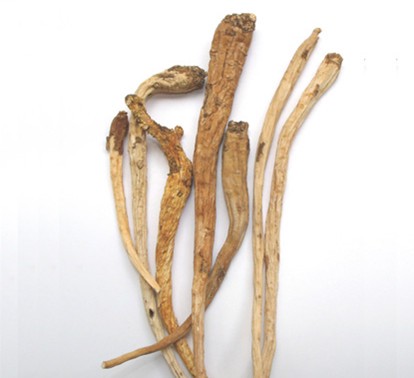 Jin Tie Suo (Radix Psammosilenes)
Jin Tie Suo: dispel wind and eliminate dampness, dissipate blood stasis and alleviate pain, remove toxicity and resolve swelling.
Fang Ji (Fourstamen Stephania Root)
Fang Ji (Fourstamen Stephania Root): dispel wind-damp, alleviate pain, clear heat and promote urination.
Jin Tie Suo (Radix Psammosilenes)
Jin Tie Suo: dispel wind and eliminate dampness, dissipate blood stasis and alleviate pain, remove toxicity and resolve swelling.
Fang Ji (Fourstamen Stephania Root)
Fang Ji (Fourstamen Stephania Root): dispel wind-damp, alleviate pain, clear heat and promote urination.
 Shui Zhi Gen: Chinese Herb Guide
Shui Zhi Gen: clear heat and eliminate dampness, dispel wind and alleviate pain.
Shui Zhi Gen: Chinese Herb Guide
Shui Zhi Gen: clear heat and eliminate dampness, dispel wind and alleviate pain.
Something this article did not cover?
Ask us directly. We reply within two days, and good questions become public articles.
Ask a question →