
Damp-Resolving Herbs
Dou Kou (Round Cardamom Fruit)
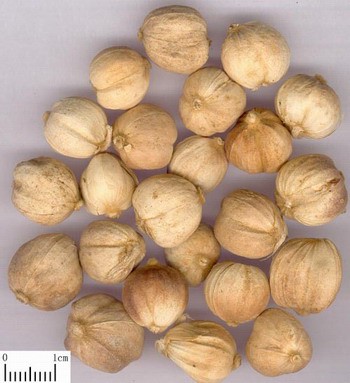
Name
Dou Kou (Fructus Amomi Rotundus), recorded in Ming Yi Bie Lu
Source and quality
The mature fruit of Amomum kravanh Pierre ex Gagnep. or A. compactum Soland ex Maton of the family Zingiberaceae.
The first is mainly produced in Thailand, Kampuchea and Vietnam, and in the Yunnan, Guangdong and Guangxi provinces of China; the second in Indonesia (Java), and in the Hainan and Yunnan provinces of China. It is collected in autumn when the fruit turns from green to yellow.
The first is fragrant and pungent with a cool flavor; the second is slightly fragrant. The best grade is large, full, intact and strongly fragrant.
It is dried in the sun and used raw, and broken when used.
Nature and action
Acrid and warm. It enters the spleen, stomach and lung meridians. It resolves dampness and moves qi, warms the middle burner and arrests vomiting.
Indications
Qi stagnation with dampness obstructing the spleen and stomach
Dou Kou is aromatic, and it is an effective herb for resolving damp turbidity, moving stagnant qi and harmonizing the spleen and stomach. It is often combined with herbs that resolve dampness, move qi and harmonize the stomach, such as Guang Huo Xiang, Chen Pi and Sha Ren.
- For qi stagnation of the spleen and stomach from food stagnation, it is combined with herbs that move qi and improve appetite, such as Mu Xiang and Sha Ren.
- For cold-damp excess, it is combined with herbs that warm the stomach and dry dampness, such as Gan Jiang, Hou Po and Cang Zhu.
- For distension in the stomach and abdomen, poor appetite and fatigue from spleen deficiency with qi stagnation, it is combined with herbs that invigorate the spleen and tonify qi, such as Huang Qi, Bai Zhu and Ren Shen.
Early stage of damp-warm disease
It is fragrant, acrid and warm without being drying, and it is good at dispersing and resolving dampness from the upper and middle burner.
- For the early stage of damp-warm disease with stuffiness of the chest and no appetite, it is often combined with herbs that ventilate the lung and drain dampness, such as Xing Ren and Yi Yi Ren in San Ren Tang from Wen Bing Tiao Bian.
- Where heat predominates over damp, it is combined with herbs that clear heat and drain dampness, such as Huang Qin and Hua Shi.
Vomiting
It moves qi and soothes the middle burner, warms the stomach and arrests vomiting. Its action resembles that of Sha Ren, but it is more aromatic and better at arresting vomiting, which makes it especially suited to qi stagnation from damp turbidity obstructing the interior, with stuffiness of the stomach and vomiting.
It can be ground into a powder and taken alone, or combined with herbs that resolve dampness, warm the middle burner and arrest vomiting, such as Sha Ren, Guang Huo Xiang and Ban Xia.
Dosage and administration
Decoct 3~6 g, or grind it into a powder for pills and powder. Add it late when decocting.
Sources and further reading
We cite classical materia medica and modern reference works. This article is health education, not medical advice.
- Shennong Bencao Jing (The Divine Farmer's Materia Medica), Han dynasty.
- Bencao Gangmu (Compendium of Materia Medica), Li Shizhen, 1578.
- Chinese Pharmacopoeia, current edition — identity, quality and safety monographs.
- NCCIH and WHO reference material on traditional medicine safety.
Spotted an error or a better source? Tell us — corrections are logged on our editorial policy page.
Did this article help you?
Your answer shapes what gets rewritten next.
Keep readingRelated entries
Bai Dou Kou (Round Cardamom Fruit)
Dou Kou (Fructus Amomi Rotundus). The mature fruit of Amomum kravanh Pierre ex Gagnep or A
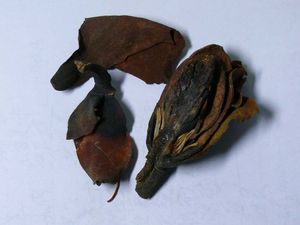 Hou Po Hua (Official Magnolia Flower)
Hou Po Hua, the flower of the official magnolia, moves qi and resolves dampness.
Hou Po Hua (Official Magnolia Flower)
Hou Po Hua, the flower of the official magnolia, moves qi and resolves dampness.
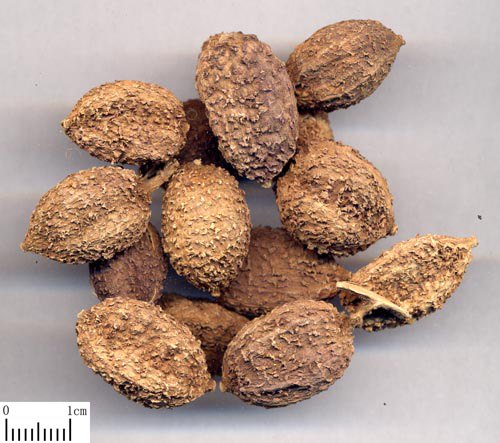 Villous Amomum Fruit (Cocklebur-like Amomum Fruit)
Sha Ren: resolve dampness and move qi, warm middle burner and arrest vomiting, check diarrhea and prevent abortion.
Sha Ren (Cocklebur-like Amomum Fruit)
Sha Ren (Cocklebur-like Amomum Fruit): resolve dampness and move qi, warm middle burner and arrest vomiting, check diarrhea and prevent abortion.
Villous Amomum Fruit (Cocklebur-like Amomum Fruit)
Sha Ren: resolve dampness and move qi, warm middle burner and arrest vomiting, check diarrhea and prevent abortion.
Sha Ren (Cocklebur-like Amomum Fruit)
Sha Ren (Cocklebur-like Amomum Fruit): resolve dampness and move qi, warm middle burner and arrest vomiting, check diarrhea and prevent abortion.
Something this article did not cover?
Ask us directly. We reply within two days, and good questions become public articles.
Ask a question →