
Edema-Alleviating Diuretics
Fu Ling: Chinese Herb Guide


Name
Fu Ling (Poria), from Shen Nong Ben Cao Jing (Shen Nong's Herbal)
Source and quality
The sclerotium of the eumycete Poria cocos (Schw.) Wolf of the family Polyporaceae. The sclerotium grows mostly on the roots of Japanese red pine and Pinus massoniana Lamb.
It is produced in Yunnan, Anhui, Hubei and Sichuan provinces, and is dug up and collected from July to September.
It has no odor and a bland taste. The best grade is large and firm, with brown skin and a pure white cross section, and it sticks strongly to the teeth when chewed.
After soaking it is slightly steamed, the white part is cut into pieces, dried in the sun and used unprocessed.
Nature and action
Sweet, bland and neutral. It enters the heart, spleen and kidney meridians.
It induces diuresis and drains dampness, invigorates the spleen and induces tranquilization.
Indications
Edema and dysuria
It induces diuresis and drains dampness to eliminate pathogens, and it invigorates the spleen to reinforce the healthy qi. Its action is mild: it is tonic without causing stagnation, and diuretic without being depleting. It is an essential herb for promoting urination and relieving edema.
- For edema of any kind, whether of cold, heat, deficiency or excess pattern, it is usually combined with Zhu Ling so that the two promote each other's diuretic and dampness-draining action. How it is combined with other herbs depends on the pattern.
- For edema and dysuria due to retention of water and dampness, it is usually combined with Zhu Ling, Ze Xie, Bai Zhu and Gui Zhi, as in Wuling San from Shang Han Lun.
- For edema due to spleen and kidney deficiency, it is usually combined with herbs that warm yang and induce diuresis, such as Fu Zi and Sheng Jiang in Zhen Wu Tang from Shang Han Lun.
- For water-heat accumulation syndrome, with edema due to yin deficiency and dysuria, it is combined with herbs that tonify yin and induce diuresis, such as Zhu Ling, E Jiao and Ze Xie in Zhuling Tang from Shang Han Lun.
- For edema due to spleen deficiency, it is usually combined with herbs that tonify qi, invigorate the spleen and induce diuresis, such as Bai Zhu and Huang Qi, so that the two reinforce each other.
Spleen deficiency syndrome
This herb is mild in invigorating the spleen, so in every syndrome of spleen deficiency it is combined with Ren Shen and Dang Shen as their assistant.
- Ren Shen, Bai Zhu and Gan Cao in Si Jun Zi Tang, the chief formula for tonifying the spleen and stomach, from Tai Ping Hui Min He Ji Ju Fang.
- The spleen governs the circulation of body fluids, so dysfunction of the spleen easily leads to retention of water and dampness. Because it is good at inducing diuresis while tonifying the spleen, it is usually combined with herbs that tonify qi and invigorate the spleen, and herbs that dry dampness and check diarrhea: Ren Shen, Bai Zhu and Yi Yi Ren in Shenling Baizhu San from Tai Ping Hui Min He Ji Ju Fang, indicated for indigestion, borborygmus and diarrhea due to spleen deficiency with damp harassment.
Palpitation and insomnia
It induces tranquilization and is indicated for palpitation and insomnia caused by various patterns.
- For palpitation, insomnia and amnesia due to qi and blood deficiency or spleen-heart deficiency, it is usually combined with herbs that tonify qi and nourish blood and herbs that calm the spirit, such as Huang Qi, Dang Gui and Yuan Zhi in Gui Pi Fang from Ji Sheng Fang.
- For restlessness and fear due to heart qi deficiency, it is usually combined with herbs that tonify heart qi and settle the spirit, such as Ren Shen, Yuan Zhi and Long Chi in An Shen Ding Zhi Wan from Yi Xue Xin Wu.
Phlegm-fluid retention
It invigorates the spleen and drains water-dampness, which prevents dampness from being retained and phlegm from forming, and it also calms the heart and induces tranquilization. It therefore suits spleen deficiency with retained fluid, and attack of the heart by retained water marked by fullness in the chest and hypochondrium, palpitation, dizziness, and cough with shortness of breath.
- For phlegm-fluid retention with fullness in the chest and hypochondrium, it is usually combined with herbs that invigorate the spleen, dry dampness and warm heart yang, such as Gui Zhi, Bai Zhu and Gan Cao in Ling Gui Zhu Gan Tang from Jin Kui Yao Lue.
- For vomiting due to fluid retention in the stomach, it should be combined with herbs that direct qi downward and arrest vomiting, such as Ban Xia and Sheng Jiang in Xiao Banxia Jia Fuling Tang from Jin Kui Yao Lue.
- Because it is good at invigorating the spleen and draining dampness, it is indicated for phlegm-damp syndromes, and is used in Erchen Tang from Tai Ping Hui Min He Ji Ju Fang to reinforce the dampness-drying and phlegm-resolving actions of Ban Xia and Chen Pi.
Dosage and administration
Decoct 9~15 g.
Cautions
Contraindicated in spermatorrhea due to deficiency-cold.
Sources and further reading
We cite classical materia medica and modern reference works. This article is health education, not medical advice.
- Shennong Bencao Jing (The Divine Farmer's Materia Medica), Han dynasty.
- Bencao Gangmu (Compendium of Materia Medica), Li Shizhen, 1578.
- Chinese Pharmacopoeia, current edition — identity, quality and safety monographs.
- NCCIH and WHO reference material on traditional medicine safety.
Spotted an error or a better source? Tell us — corrections are logged on our editorial policy page.
Did this article help you?
Your answer shapes what gets rewritten next.
Keep readingRelated entries
 Wu Yu Dan: Chinese Herb Guide
Wu Yu Dan (Cuttlefish nidamental gland) Salt, neutral; stomach and kidney channels. Actions Strengthen the spleen and promote urination
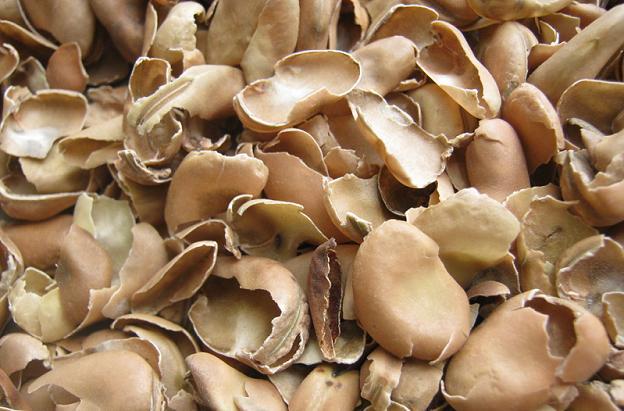 Can Dou Ke (Seed-coat of Broadbean)
Can Dou Ke: promote urination, eliminate dampness, stop bleeding, remove toxicity.
Shu Luo Bo: Chinese Herb Guide
Shu Luo Bo: promote urination and resolve swelling, activate blood and dissipate blood stasis.
 Shui Cong: Chinese Herb Guide
Shui Cong (Scirpus tabernaemontani) Sweet, bland, neutral; bladder channel. Actions Eliminate dampness and promote urination
Something this article did not cover?
Ask us directly. We reply within two days, and good questions become public articles.
Ask a question →