
Wind-Extinguishing and Spasm-Stopping Herbs
Gou Teng (Ramulus Uncariae cum Uncis)
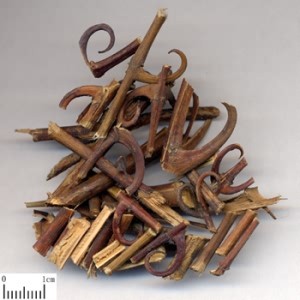
Name
Gou Teng (Ramulus Uncariae cum Uncis), from Ming Yi Bie Lu (Miscellaneous Records of Famous Physicians)
Source and quality
The dry stems and branches with hooks of the perennial herbs Uncaria rhynchophylla (Miq.) Jacks, U. macrophylla Wall., U. hirsuta Havil., U. sinensis (Oliv.) Havil. or U. sessilifructus Roxb. of the family Rubiaceae. It is produced south of the Yangtze River in China and collected in spring and autumn.
It has no unpleasant odor and no unpleasant taste. The best grade has double hooks, a slender stem, durable hooks and a violet-red color, with no withered stem or hook.
The leaves are removed and it is dried in the sun, cut into segments and used unprocessed.
Nature and action
Sweet and slightly cold. It enters the liver and pericardium meridians.
It extinguishes wind and stops spasm, clears liver heat and pacifies the liver.
Indications
Syndrome of stirring of liver wind
Its actions of extinguishing wind and stopping spasm and of clearing liver heat are moderate, so it is usually indicated for stirring of liver wind, convulsive epilepsy and convulsions, and especially for generation of wind by extreme heat and for infantile convulsions due to high fever. It is often combined with other herbs that clear heat, extinguish wind and stop spasms, so as to reinforce these actions.
- For generation of wind by extreme heat, with spasm and convulsions in epidemic warm diseases, it is often combined with Ling Yang Jiao, Bai Shao and Ju Hua in Lingjiao Gouteng Tang from Tong Su Shang Han Lun (Popular Treatise on Cold-Induced Diseases).
- For infantile convulsions with high fever, coma, locked jaw and spasm of the limbs, it is often combined with Tian Ma, Quan Xie and Chan Tui.
Syndrome of hyperactivity of liver yang
It both clears liver heat and pacifies liver yang, so it is usually indicated for a feeling of fullness in the head, headache and dizziness due to up-flaring of liver fire or to hyperactivity of liver yang.
- For liver fire invading upward, it is often combined with herbs that clear liver heat and purge liver fire, such as Xia Ku Cao, Long Dan Cao and Zhi Zi.
- For hyperactivity of liver yang, it is often combined with herbs that pacify the liver and subdue yang, such as Tian Ma and Shi Jue Ming, in Tianma Gouteng Yin from Za Zheng Zheng Zhi Xin Yi (New Explanation of Syndrome Differentiation on Miscellaneous Symptoms).
Dosage and administration
Decoct 3~12 g. Add it later than the other herbs so that its active ingredients are not destroyed.
Sources and further reading
We cite classical materia medica and modern reference works. This article is health education, not medical advice.
- Shennong Bencao Jing (The Divine Farmer's Materia Medica), Han dynasty.
- Bencao Gangmu (Compendium of Materia Medica), Li Shizhen, 1578.
- Chinese Pharmacopoeia, current edition — identity, quality and safety monographs.
- NCCIH and WHO reference material on traditional medicine safety.
Spotted an error or a better source? Tell us — corrections are logged on our editorial policy page.
Did this article help you?
Your answer shapes what gets rewritten next.
Keep readingRelated entries
Uncaria Rhynchophylla (Ramulus Uncariae cum Uncis)
Gou Teng (Uncaria Rhynchophylla). The dry stem and and brach with hooks of perennial herb U. rhynchophylla (Miq.) Jacks, U
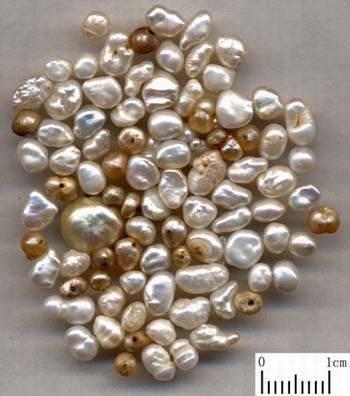 Zhen Zhu (Pearl): Actions, Dose and Cautions
Pearl (Zhen Zhu) is a mineral used in TCM to calm the spirit, settle fright and help heal sores.
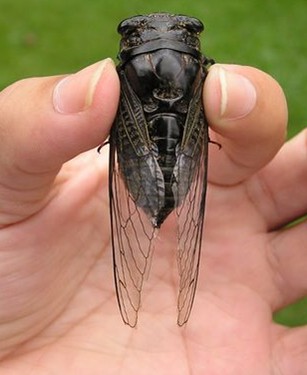 Zha Chan (Cicada) in TCM
Zha Chan (Cicada) Salty, sweet, cold; liver and lung channels. Actions Clear heat and relieve convulsion
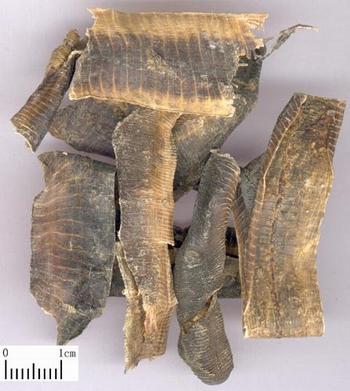 Pberetima (Lumbricus) in TCM
Di Long: clear heat and extinguish wind, unblock collateral, relieve wheezing, promote urination.
Something this article did not cover?
Ask us directly. We reply within two days, and good questions become public articles.
Ask a question →