
Heat-Clearing and toxicity-Removing Herbs
Qing Dai (青黛)
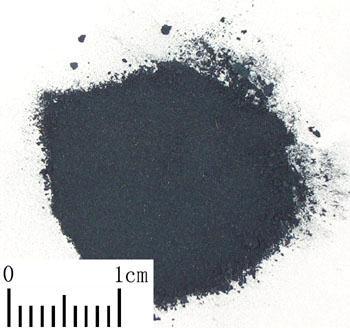
Name
Qing Dai (Indigo Naturalis), recorded in Yao Xing Lun.
Source and quality
Plant
A dried powder or clumping mass processed from the leaves or leafy stems of Baphicacanthus cusia (Nees) Bremek., Polygonum tinctorium Ait. or Isatis indigotica Fort., family Acanthaceae.
Where it is grown
Fujian, Yunnan, Jiangsu, Anhui and Hebei provinces. The Fujian product, Jian Qing Dai, is the best grade.
Harvest
Stems and leaves are cut in summer and autumn and left soaking until the leaves decay and the stems can be decorticated; the stems are then discarded. An appropriate amount of lime cream is stirred into the infusion until the color changes from dark green to deep red, and it is dried once the surface foam has gone.
Smell and taste
Faintly grassy smell; bland.
Better grade
Fine, blue, light and loose enough to float on water, burning with a purplish-red flame.
Nature and action
Bitter, salty and cold; enters the liver, heart, lung and stomach channels. Clears heat and removes toxicity, cools the blood, and clears liver fire.
When it is used
Macular rash from epidemic toxicity
Qing Dai is the processed form of Da Qing Ye and shares its action of clearing heat, removing toxicity and cooling the blood. Because it is weaker at removing toxicity and relieving fever than Da Qing Ye, it is not used as widely for warm diseases; it is used for them mainly where a macular rash has broken out from epidemic toxicity.
It may be used alone, as in the book of Lei Zheng Huo Ren Shu for cold-pathogen disease with reddish macular rash. It is also combined with herbs that clear heat and purge fire, cool the blood and remove toxicity, as with Shi Gao, Sheng Di Huang, Sheng Ma and Huang Qin in Qing Dai Shi Gao Tang from Chong Ding Tong Su Shanghan Lun.
Sore throat, mouth ulcers, sores and mumps from heat-toxin
Because it clears heat and removes toxicity, cools the blood and relieves swelling, it is indicated in many heat-toxin syndromes, taken by mouth or applied externally.
Where heat-toxin is excessive and the throat is swollen and sore, or the mouth and tongue are ulcerated, swollen, painful or rotten, it is combined with herbs that clear heat and remove toxicity, relieve swelling and stop pain, such as Niu Huang and Bing Pian in Xi Lei San from Jingui Yaolue Bu Yi, powdered and blown onto the affected area.
For heat-toxin sores and ulcers it can be applied alone, or combined with heat-clearing, fire-purging and toxicity-removing herbs: in Qing Jin San from Pu Ji Fang it is pounded together with Han Shui Shi and applied topically to strengthen its effect. For heat-toxin sores and abscesses the result is much better when combined with heat-clearing, toxicity-removing and dampness-drying herbs such as Huang Lian and Huang Bai.
For mumps it can be used by mouth or topically. In Ling Nan Cai Yao Lu it is applied alone; the effect improves when it is combined with Ban Lan Gen and Da Qing Ye.
Bleeding from blood heat
Because it clears heat and cools the blood, it is used for the various bleeding syndromes driven by blood heat, either alone or more often combined with herbs that clear heat, cool the blood and stop bleeding.
For incessant vomiting of blood it is used alone in Qing Jin San from Duan Xiao Fang. For hemoptysis it is combined with blood-cooling and bleeding-stopping herbs such as Zhi Zi in Ke Xue Fang from Dan Xi Xin Fa, and with Xing Ren in Sheng Bing Zi from Zhong Cang Jing. For nosebleed its powder can be applied to sterilized cotton and packed into the nostril to press on the bleeding point.
Cough with hemoptysis
It clears heat from both lung and liver while also cooling the blood, so it is used when liver fire invades the lung and damages the lung collaterals, producing cough, chest pain, hemoptysis or blood-flecked phlegm. It is often combined with herbs that resolve phlegm and stop cough, as with Hai Ge Ke in Dai Ge San from Wei Sheng Hong Bao, the two clearing lung heat and resolving phlegm while stopping cough and bleeding.
For cough with thick yellow sputum from lung heat it is combined with herbs that clear heat and resolve phlegm: Hai Fu Shi, Gua Lou Ren and Chuan Bei Mu in Qing Dai Hai Shi Wan from Zheng Yin Mai Zhi.
Convulsions from liver heat in infants
Because it clears liver heat it is used for infantile wind generated by liver heat, with convulsions and epilepsy. It does not itself extinguish wind or stop convulsions, so it must be combined with herbs that clear heat, extinguish wind and stop convulsions, such as Gou Teng and Niu Huang in Liang Jing Wan from Xiao'er Yao Zheng Zhi Jue.
Dose
Take 1.5~3g by mouth. Use it in pills or powder rather than in decoction, because it does not dissolve in water and would leave a cloudy liquid that is hard to strain. Use externally by dusting on as dry powder or applying as a paste.
Sources and further reading
We cite classical materia medica and modern reference works. This article is health education, not medical advice.
- Shennong Bencao Jing (The Divine Farmer's Materia Medica), Han dynasty.
- Bencao Gangmu (Compendium of Materia Medica), Li Shizhen, 1578.
- Chinese Pharmacopoeia, current edition — identity, quality and safety monographs.
- NCCIH and WHO reference material on traditional medicine safety.
Spotted an error or a better source? Tell us — corrections are logged on our editorial policy page.
Did this article help you?
Your answer shapes what gets rewritten next.
Keep readingRelated entries
 Radix Isatidis (Isatis Root): Pharmacognosy and Uses
Ban Lan Gen (Indigowoad Root) clears heat and removes toxicity, cools the blood and alleviates sore throat. It is especially good at clearing heat-toxin in.
 Iron Rust: Chinese Herb Guide
Iron Rust: clear heat and remove toxicity, relieve palpitation and calm the liver.
Qing Dai: Chinese Herb Guide
Qing Dai (Indigo Naturalis) — Yao Xing Lun (Treatise on Herb Property) A kind of dried powder or clumping processed from the leaf or stem with leaf of
 Chong Lou (Chinese Paris Rhizome)
Chong Lou: clear heat and remove toxicity; relieve swelling and pain; cool liver and stop convulsions.
Something this article did not cover?
Ask us directly. We reply within two days, and good questions become public articles.
Ask a question →