
Wind-Cold-Dispersing Herbs
Qiang Huo (Notopterygium)
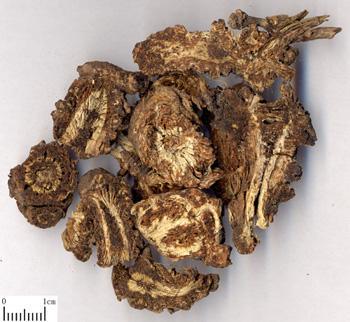
Name
Qiang Huo (Notopterygium rhizome and root, Rhizoma seu Radix Notopterygii), recorded in the Shennong Bencao Jing.
Source and quality
Plant
The dried rhizome and root of Notopterygium incisum Ting ex H. T. Chang or N. franchetii (often listed as N. forbesii), family Apiaceae (Umbelliferae).
Where it is grown
N. incisum is mainly from Sichuan, Yunnan and Qinghai. N. franchetii is mainly from Sichuan, Qinghai, Shanxi and Henan.
Harvest
Collected in spring and autumn.
Smell and taste
Aromatic; slightly bitter and acrid.
Better grade
Stout pieces with dark brown skin, many reddish spots on the cut face, and a strong smell.
Processing
Sliced; used unprocessed.
Nature and action
Acrid, bitter, warm; enters the lung and bladder channels. Releases the exterior and disperses cold; expels wind-damp; eases pain.
When it is used
Wind-cold on the exterior
Qiang Huo is a strong cold-dispersing, damp-expelling, pain-easing herb. It fits an exterior wind-cold pattern that also has damp: chills and fever, no sweat, headache, stiff nape, heavy aching limbs. It is often paired with other wind-cold and damp-expelling herbs — for example Fang Feng and Chuan Xiong in Jiu Wei Qiang Huo Tang, or Du Huo, Gao Ben and Fang Feng in Qiang Huo Sheng Shi Tang.
Wind-cold-damp bi (aching joints and flesh)
Because it enters the taiyang bladder channel and is good for headache, shoulder and upper-back pain, it is especially used when the ache sits in the upper body. It is often combined with wind-damp and blood-moving herbs, as in Juan Bi Tang with Fang Feng and Dang Gui. For headache from wind-cold or wind-damp it is commonly used with Chuan Xiong, Bai Zhi and Gao Ben.
Dose
Decoction 3–10 g.
Cautions
Use carefully in blood deficiency: the herb is strongly acrid, aromatic, warm and drying. Large amounts can provoke vomiting, so it is a poor fit when the spleen and stomach are already weak.
Sources and further reading
We cite classical materia medica and modern reference works. This article is health education, not medical advice.
- Shennong Bencao Jing (The Divine Farmer's Materia Medica), Han dynasty.
- Bencao Gangmu (Compendium of Materia Medica), Li Shizhen, 1578.
- Chinese Pharmacopoeia, current edition — identity, quality and safety monographs.
- NCCIH and WHO reference material on traditional medicine safety.
Spotted an error or a better source? Tell us — corrections are logged on our editorial policy page.
Did this article help you?
Your answer shapes what gets rewritten next.
Keep readingRelated entries
 Du Heng (Forbes Wildginger Herb)
: dispel wind and dissipate cold, alleviate pain, eliminate phlegm and relieve cough.
 Sheng Teng (Stem of Common Stelmatocrypton)
: dispel wind-cold, promote the flow of qi and dredge meridians.
 Xi Xin (Manchurian Wildginger)
: relieve exterior and dispel cold, dispel wind to alleviate pain, free nasal orifice and warm orifice and warm lung and.
 Gao Ben (Chinese Ligusticum Rhizome)
Gao Ben (Radices Ligustici Sinensis) Acrid, warm; lung channel. Actions Dispel wind-cold, relieve damp and alleviate pain
Something this article did not cover?
Ask us directly. We reply within two days, and good questions become public articles.
Ask a question →