
Heat-Phlegm-Clearing and Resolving Herbs
Hai Zao (Sargassum) in TCM
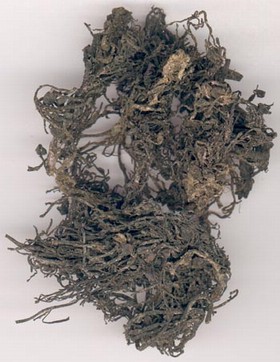
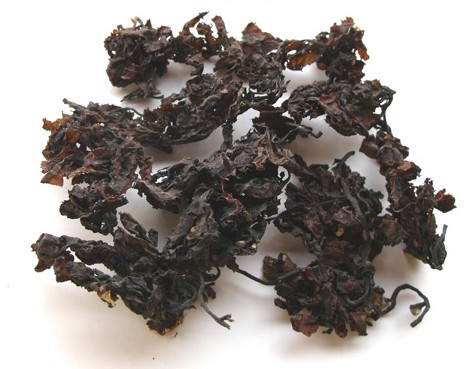
Name
Hai Zao (Sargassum), recorded in the Shennong Bencao Jing.
Source and quality
Plant
The dried alga of Sargassum pallidum (Turn.) C. Ag. or S. fusiforme (Harv.) Setch., family Sargassaceae.
Where it is grown
Coastal areas.
Harvest
Collected in summer and autumn.
Smell and taste
Fishy smell; slightly salty.
Better grade
Dry, black-brown, with little salt efflorescence, tender twigs, and free of sand.
Processing
Used unprocessed.
Nature and action
Salty and cold; enters the liver, stomach and kidney channels. Dissolves phlegm and softens hardness, promotes urination and eases edema.
When it is used
Scrofula, goiter, and swollen painful testis
Hai Zao removes phlegm, softens hardness and dissipates nodules. It is indicated mainly for scrofula, goiter, and swollen, distending, painful testis, where phlegm and qi accumulate together and congeal into a mass.
For scrofula and goiter it is often combined with other herbs that soften hardness and resolve phlegm, such as Kun Bu and Bei Mu in Hai Zao Yu Hu Tang from Yi Zong Jin Jian. For swollen, distending, painful testis from congealing phlegm and stagnant qi it is combined with herbs that soothe the liver, move qi and resolve phlegm, such as Ju He, Kun Bu and Chuan Lian Zi in Ju He Wan from Ji Sheng Fang.
Edema, and damp turbidity flowing downward to the foot
It induces urination and resolves swelling, but the action is not strong enough on its own, so it is often combined with herbs that induce urination and drain dampness to strengthen the effect, such as Fu Ling, Zhu Ling and Ze Xie.
Dose
Decoction 10~15 g. Use in wine, or in pills and powder, as appropriate.
Cautions
Contraindicated with Gan Cao.
Sources and further reading
We cite classical materia medica and modern reference works. This article is health education, not medical advice.
- Shennong Bencao Jing (The Divine Farmer's Materia Medica), Han dynasty.
- Bencao Gangmu (Compendium of Materia Medica), Li Shizhen, 1578.
- Chinese Pharmacopoeia, current edition — identity, quality and safety monographs.
- NCCIH and WHO reference material on traditional medicine safety.
Spotted an error or a better source? Tell us — corrections are logged on our editorial policy page.
Did this article help you?
Your answer shapes what gets rewritten next.
Keep readingRelated entries
Hai Zao: Chinese Herb Guide
Hai Zao (Sargassum). The dry algae of plant Sargassum pallidum (Turn.) C. Ag. or S. fusiforme. (Harv.) Setch
 Meng Shi: Chinese Herb Guide
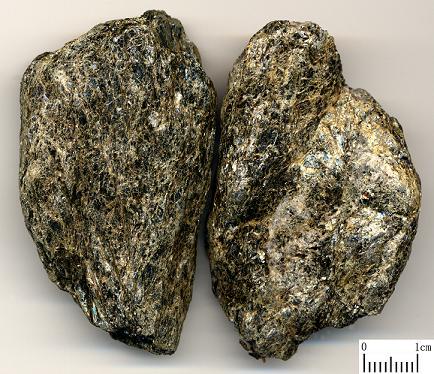
Meng Shi: eliminate phlegm down and direct qi downward, pacify liver and relieve convulsions.
Yang Ye: Chinese Herb Guide
Yang Ye (Goat or sheep thyroid) Sweet, bland, warm; lung channel. Actions Resolve phlegm and relieve goiter. When it is used Provoked goiter
 Kun Bu: Chinese Herb Guide
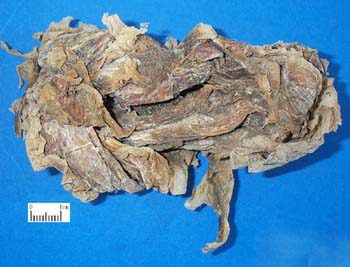
Kun Bu (Ecklonia kurome Okam). The dry pedalium of plant Laminaria japonica Aresch. or Ecklonia kurome Okam. of family Alariaceae
Something this article did not cover?
Ask us directly. We reply within two days, and good questions become public articles.
Ask a question →