
Putridity-Resolving and Wound-Healing Herbs
Sheng Yao (升药)
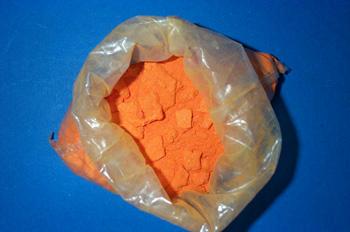
Naming
Sheng Yao (Hydrargyrum Oxydatum Crudum)——Yao Cai Zi Liao Hui Bian (Glossary of Reference Material of Medicinal Herbs)
The Processing of 升药
Origin
Mixed sublime of mercury, nitrum and alum.
Location
Mainly in Hebei, Hubei and Hunan provinces of China, the red color one called Hong Sheng, and the yellow color one called Huang Sheng.
The actual smell and taste
Without bad smell.
Best quality
Without shattered pieces, with luster and long time stored.
Processing
Ground into fine powders.
The Effect of 升药
Property
Pungent, hot; strong toxic.
Actions
Discharge pus and remove putridity.
Indications
The remained of pus or putrid tissue after the ulceration of abscess and deep-rooted carbuncle make new tissue difficult to grow. This herb has a good action of discharging pus and removing putridity, so it is the key herb for discharging pus and removing putridity for surgical department. Being strong toxic, it is seldom used purely in clinic, so it is often combined with dampness-astringing and wound-healing herbs, such as calcined Shi Gao. The proportion of the two herbs is usually adjusted according to the disease situation. For instance, if the proportion of them is one to nine, called Jiu Yi Dan, which have weak action of draining toxin, but strong actions of astringing dampness and promoting the regeneration of tissue. If it is two to eight, called Ba Er Dan, three to seven called Qi San Dan, one to one called Wu Wu Dan and nine to one called Jiu Zhuan Dan. With the increase of the dose of Sheng Yao, the actions of draining toxin and discharging pus are gradually intensified. Meanwhile, it can be cast to the afflicted sites, or sticked to the cotron paper to insert into the pus cavity.In addition, Sheng Yao can also be indicated externally for eczema, impetigo, stubborn tinea and syphilis.
Dosage and Administrations
Take proper dose for external application.
Cautions
Being strong toxic, it can only be indicated externally. For external application, it should not be used for overdose or persistent use. The poisoning manifestations of this herb are similar to Qing Fen.
Sources and further reading
We cite classical materia medica and modern reference works. This article is health education, not medical advice.
- Shennong Bencao Jing (The Divine Farmer's Materia Medica), Han dynasty.
- Bencao Gangmu (Compendium of Materia Medica), Li Shizhen, 1578.
- Chinese Pharmacopoeia, current edition — identity, quality and safety monographs.
- NCCIH and WHO reference material on traditional medicine safety.
Spotted an error or a better source? Tell us — corrections are logged on our editorial policy page.
Did this article help you?
Your answer shapes what gets rewritten next.
Keep readingRelated entries
Sheng Yao: Chinese Herb Guide
Sheng Yao (Hydrargyrum Oxydatum Crudum) — Yao Cai Zi Liao Hui Bian (Glossary of Reference Material of Medicinal Herbs) Mixed sublime of mercury, nitru
Ta Pi Mao: Chinese Herb Guide
Ta Pi Mao (Otter skin and fur) Bitter, cool; kidney channels. Actions Promote urination, remove toxicity, stop bleeding
 Shui Min (水黾): Chinese Herb Guide
Shui Mian (Water skipper) Toxic; heart and liver channels. Actions Prevent malaria and heal haemorrhoid. When it is used Malaria and haemorrhoid
 E Mao: Chinese Herb Guide
E Mao (Goose feathers) Salt, cool; gallbladder and lung channels. Actions Remove toxicity and resolve swelling, astringe wound
Something this article did not cover?
Ask us directly. We reply within two days, and good questions become public articles.
Ask a question →