
Wind-Extinguishing and Spasm-Stopping Herbs
Tall Gastrodia Tuber (Rhizoma Gastrodiae)
Name
Tian Ma (Rhizoma Gastrodiae), recorded in the Shennong Bencao Jing.
Source and quality
Plant
The dried tuber of Gastrodia elata Bl., family Orchidaceae.
Where it is grown
Sichuan, Guizhou and Yunnan provinces.
Harvest
Lifted in winter or spring. Winter lifting gives Dong Ma, which is the better grade; spring lifting gives Chun Ma, of poorer quality.
Smell and taste
Distinctive smell; sweet.
Better grade
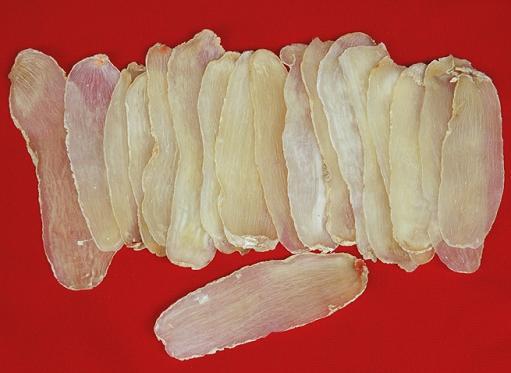
Solid. One end bears withered buds with a brownish-red color, commonly called Ying Ge Zhui; the other end shows the rounded umbiliform scar left where it separated from the mother plant. The surface has natural transverse striations, the color is yellow-white, the cross-section is bright, and the center is hollow-free.
Processing
Lifted, the stem and fibrous roots removed, washed and dried at low temperature; alternatively soaked until thoroughly moist and then sliced, used raw.
Nature and action
Sweet and neutral; enters the liver channel. Extinguishes wind and stops spasm, pacifies liver yang, and dispels wind and unblocks the collaterals.
When it is used
Stirring of liver wind
Because it is sweet, moistening and mild, with a good gentle action of extinguishing wind and stopping spasm, it is combined with other herbs to treat stirring of liver wind, fright epilepsy and convulsions of any origin, whether heat or cold, deficiency or excess.
For acute infantile convulsions it is often combined with herbs that clear the liver, extinguish wind and stop spasm, such as Ling Yang Jiao, Gou Teng and Quan Xie. For chronic infantile convulsions from spleen deficiency it is combined with herbs that tonify the spleen and stomach with herbs that extinguish wind and stop spasm, such as Ren Shen, Bai Zhu and Jiang Can. For an epileptic attack from wind-phlegm obstruction it is combined with herbs that resolve phlegm and extinguish wind to bring the patient round, such as Dan Nan Xing, Quan Xie and Shi Chang Pu.
Liver yang hyperactivity
It is the key herb for dizziness and headache, because it extinguishes liver wind and pacifies liver yang, and it is combined with other herbs according to the kind of dizziness and headache.
For dizziness and headache from hyperactivity of liver yang it is often combined with herbs that clear heat and pacify the liver, as with Gou Teng, Shi Jue Ming and Huang Qin in Tian Ma Gou Teng Yin. For dizziness and headache from upward disturbance by wind-phlegm it is often combined with herbs that invigorate the spleen, dry dampness and resolve phlegm, as with Ban Xia, Bai Zhu and Fu Ling in Ban Xia Bai Zhu Tian Ma Tang. For migraine it is often combined with herbs that extinguish wind, stop spasm, dispel wind and relieve pain, such as Chuan Xiong in Chuan Xiong Wan.
Wind stroke and wind-damp painful obstruction
It dispels exogenous wind and unblocks the collaterals. Where wind attacks the channels, with paralysis and numbness of the limbs, it is often combined with herbs that nourish qi and blood, move the blood and unblock the collaterals, such as Huang Qi, Dang Gui and Chuan Xiong. For wind-damp painful obstruction, with pain and limited flexion and extension of the joints, it is often combined with herbs that dispel wind and dampness, such as Qin Jiao, Qiang Huo and Sang Zhi.
Dose
Decoction 3~10 g. As powder, 1~1.5 g.
Sources and further reading
We cite classical materia medica and modern reference works. This article is health education, not medical advice.
- Shennong Bencao Jing (The Divine Farmer's Materia Medica), Han dynasty.
- Bencao Gangmu (Compendium of Materia Medica), Li Shizhen, 1578.
- Chinese Pharmacopoeia, current edition — identity, quality and safety monographs.
- NCCIH and WHO reference material on traditional medicine safety.
Spotted an error or a better source? Tell us — corrections are logged on our editorial policy page.
Did this article help you?
Your answer shapes what gets rewritten next.
Keep readingRelated entries
 Di Long (Lumbricus) in TCM
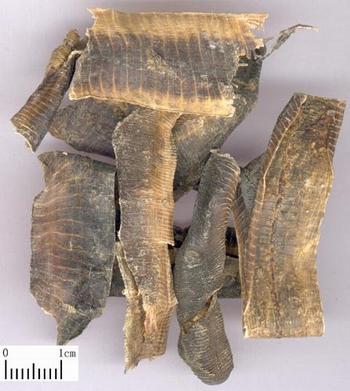
Earthworm: clear heat and extinguish wind, unblock collateral, relieve wheezing, promote urination.
Pberetima (Lumbricus) in TCM
Di Long: clear heat and extinguish wind, unblock collateral, relieve wheezing, promote urination.
Tian Ma (Tall Gastrodia Tuber)
Tian Ma (Tall Gastrodia Tuber): extinguish wind and stop spasm, pacify liver yang, dispel wind and unblock collateral.
 Jiang Can: Chinese Herb Guide
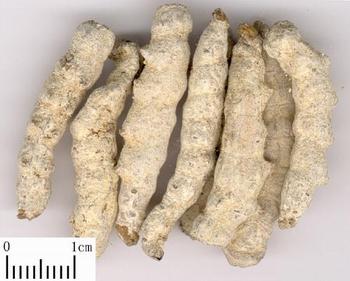
Jiang Can: extinguish wind and stop spasm, dispel wind and alleviate pain, resolve phlegm and dissipate accumulation.
Something this article did not cover?
Ask us directly. We reply within two days, and good questions become public articles.
Ask a question →