
Deficiency-Heat-Clearing Herbs
Yin Chai Hu (Starwort Root)
Naming
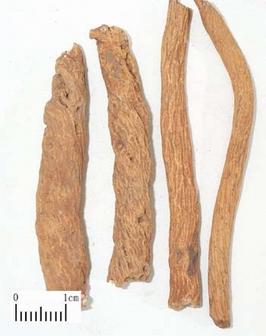
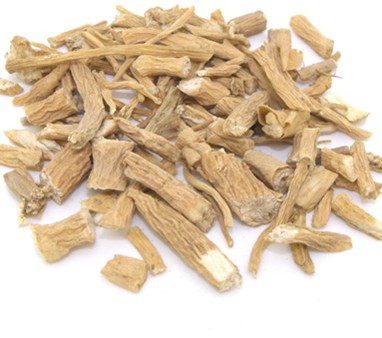
Yin Chai Hu (Radix Stellariae)——Ben Cao Gang Mu Shi Yi (Supplement to Compendium of Materia Medica)
The Processing of 银柴胡
Origin
The root of Stellaria dichotoma L. var. lanceolata Bge of family Pink.
Location
Inner Mongolia Autonomous Region and northwest of China.
Harvest
Collected in spring and summer when plant sprouting, or in the end of autumn when stem and leaf withered.
The actual smell and taste
Light smell, slight sweet taste.
Best quality
Even volume, fine root bark, solid texture, gray-yellow peel, yellow-white cross-section with center in chrysanthemum-like shape.
Processing
Dried after throwing the extra stem, fibrous root and sands away; sliced and unprocessed.
The Effect of 银柴胡
Property
Sweet, slightly bitter, light cold; liver and stomach meridians entered.
Actions
Clear deficiency heat.
Indications
Bone-steaming, strain fever, malnutrition fever
It mainly excels at clearing deficiency heat, relieving malnutrition fever, and is commonly indicated for syndrome of liver and kidney deficiency manifested as bone-steaming, strain fever, tidal fever and night sweat. It is often combined with yin-nourishing and heat-clearing herbs such as Bie Jia and Di Gu Pi in Qing Gu San from Zheng Zhi Zhun Sheng.
For the residual pathogenic in terminal stage of warm diseases manifested as lingering lowgrade fever, it is often combined with herbs in fragrant nature and clearing action so as to get reinforcement, such as Qing Hao, Bie Jia and Mu Dan Pi, etc., for instance, it is combined with Bie Jia in Yin Jia San recorded in Wen Zheng Zhi Gui (Guideline on Epidemic Warm Disease).
Furthermore, it is also excels at reducing malnutrition fever.
For food or parasite stagnation induced children's malnutrition fever, abdominal intumescence, emaciation, thirst and withered hair, it is often combined with spleen-invigorating, qi-tonifying, digestant and vermifugal herbs to mutually take effects of resolving food-stagnation, killing parasites, invigorating spleen and curing malnutrition. For instance, it is combined with Bai Zhu, Shi Jun Zi and so on in Chai Hu Qing Gan San recorded in Yi Zong Jin Jian.
Dosage and Administrations
Decoct 3~9 g.
Sources and further reading
We cite classical materia medica and modern reference works. This article is health education, not medical advice.
- Shennong Bencao Jing (The Divine Farmer's Materia Medica), Han dynasty.
- Bencao Gangmu (Compendium of Materia Medica), Li Shizhen, 1578.
- Chinese Pharmacopoeia, current edition — identity, quality and safety monographs.
- NCCIH and WHO reference material on traditional medicine safety.
Spotted an error or a better source? Tell us — corrections are logged on our editorial policy page.
Did this article help you?
Your answer shapes what gets rewritten next.
Keep readingRelated entries
Yin Chai Hu: Chinese Herb Guide
Yin Chai Hu (Radix Stellariae). (Supplement to Compendium of Materia Medica) The root of Stellaria dichotoma L. var
 Hu Huang Lian: Chinese Herb Guide
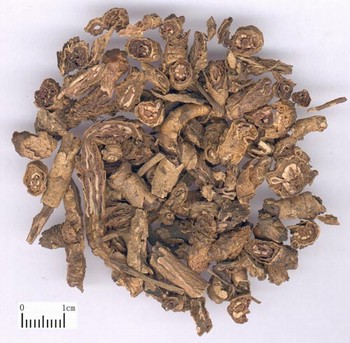
Hu Huang Lian: clear deficiency heat, relieve malnutrition fever, clear heat and resolve dampness.
Hu Huang Lian: Chinese Herb Guide
Hu Huang Lian: clear deficiency heat, relieve malnutrition fever, clear heat and resolve dampness.
 Di Gu Pi (Chinese Wolfberry Root-bark)
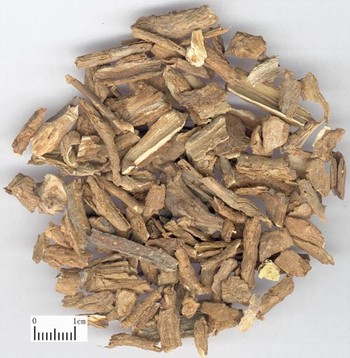
: clear deficiency heat, clear lung fire, cool blood.
Di Gu Pi: Chinese Herb Guide
Name Di Gu Pi (Cortex Lycii) — Shennong Bencao Jing Source and quality Plant The root bark of Lycium chinense Mill or Ningxia L. barbarum L. of family Arbustum.
Di Gu Pi (Chinese Wolfberry Root-bark)
Di Gu Pi (Chinese Wolfberry Root-bark): clear deficiency heat, clear lung fire, cool blood.
Di Gu Pi: Chinese Herb Guide
Name Di Gu Pi (Cortex Lycii) — Shennong Bencao Jing Source and quality Plant The root bark of Lycium chinense Mill or Ningxia L. barbarum L. of family Arbustum.
Something this article did not cover?
Ask us directly. We reply within two days, and good questions become public articles.
Ask a question →