
Edema-Alleviating Diuretics
Ze Xie (Oriental Waterplantain Rhizome)
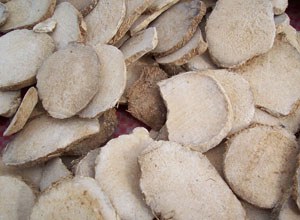
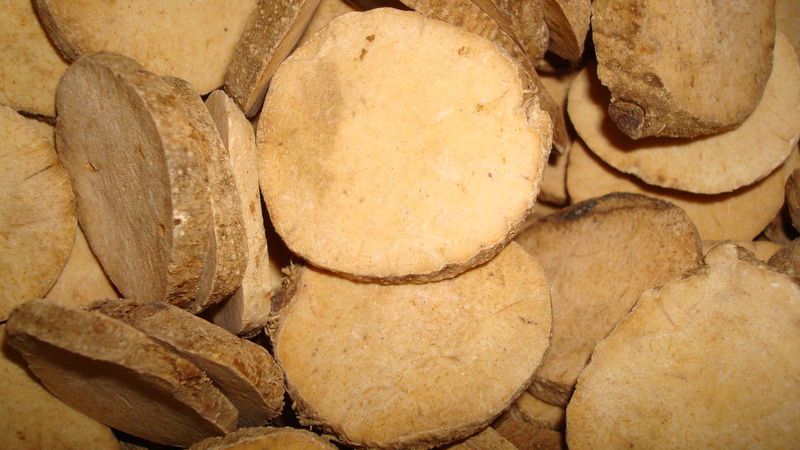
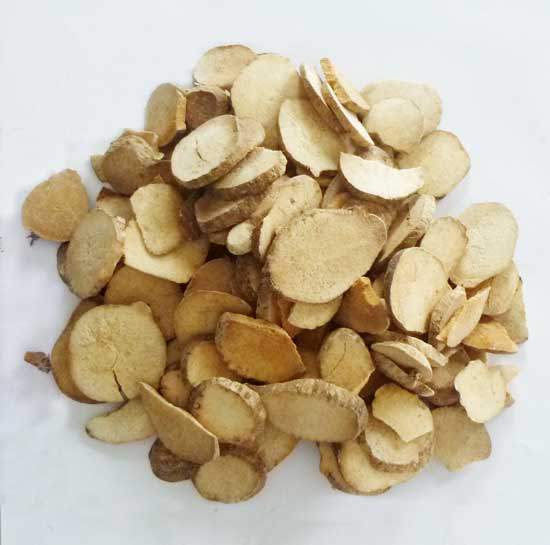
Name
Ze Xie (Rhizoma Alismatis), from Shen Nong Ben Cao Jing (Shen Nong's Herbal)
Source and quality
The stem tuber of Alisma orientalis (Sam.) Juzep. of the family Alismataceae. It is produced in Fujian, Sichuan and Jiangxi provinces, and dug up in winter when the tuber and leaves turn yellow.
It has a slight odor and is slightly bitter. The product from Fujian and Jiangxi provinces, called Jian Ze Xie, is the finest grade; a large, firm, white-to-yellow tuber rich in powder is good.
It is sliced and used raw, or baked with bran or with salt water.
Nature and action
Sweet, bland and cold. It enters the kidney and bladder meridians.
It induces diuresis, drains dampness and purges heat.
Indications
Edema and dysuria
Because it is bland in flavor it drains dampness, and its diuretic action is stronger than that of Fu Ling. It is therefore usually indicated for water-damp syndromes and combined with Fu Ling and Zhu Ling so that the two reinforce each other's diuretic and dampness-draining action.
- For edema and dysuria due to retention of water and dampness, it is usually combined with Fu Ling, Zhu Ling, Gui Zhi and Bai Zhu: Wuling San in Shang Han Lun.
- For edema and dysuria due to yin deficiency with heat, it is combined with Fu Ling, Zhu Ling and E Jiao: Zhuling Tang in Shang Han Lun.
Phlegm-fluid retention
It induces diuresis, drains dampness and resolves phlegm-fluid, and is indicated for dizziness and vertigo caused by phlegm-fluid retention and failure of clear yang to ascend. It is usually combined with herbs that drain or dry dampness, such as Bai Zhu in Zexie Tang from Jin Kui Yao Lue.
Stranguria and diarrhea
It not only induces diuresis and drains dampness but also clears bladder heat and purges kidney fire, and is indicated for damp-heat in the lower energizer.
- For stranguria of the damp-heat type, with scanty dark urine, dribbling, and difficult, painful urination, it is usually combined with Mu Tong and Che Qian Zi so that the heat-clearing action is reinforced.
- It can also promote urination and thereby make the stool well formed, so it is usually indicated for diarrhea due to excess dampness, and is combined with herbs that invigorate the spleen, drain dampness and check diarrhea, such as Fu Ling, Zhu Ling and Yi Yi Ren.
- It is also used in yin-nourishing formulas to purge ministerial fire and protect yin. For seminal emission and tidal fever due to kidney yin deficiency with ministerial fire hyperactivity, it is combined with Shu Di Huang, Shan Zhu Yu and Shan Yao: Liuwei Dihuang Wan from Xiao Er Yao Zheng Zhi Jue.
Dosage and administration
Decoct 5~10 g.
Sources and further reading
We cite classical materia medica and modern reference works. This article is health education, not medical advice.
- Shennong Bencao Jing (The Divine Farmer's Materia Medica), Han dynasty.
- Bencao Gangmu (Compendium of Materia Medica), Li Shizhen, 1578.
- Chinese Pharmacopoeia, current edition — identity, quality and safety monographs.
- NCCIH and WHO reference material on traditional medicine safety.
Spotted an error or a better source? Tell us — corrections are logged on our editorial policy page.
Did this article help you?
Your answer shapes what gets rewritten next.
Keep readingRelated entries
Ze Xie: Chinese Herb Guide
Name Ze Xie (Rhizoma Alismatis) — Shennong Bencao Jing Source and quality Plant The stem tuber of Alisma orientalis (Sam.) Juzep. of family Alismataceae.
 Grifola (Polyporus) in TCM
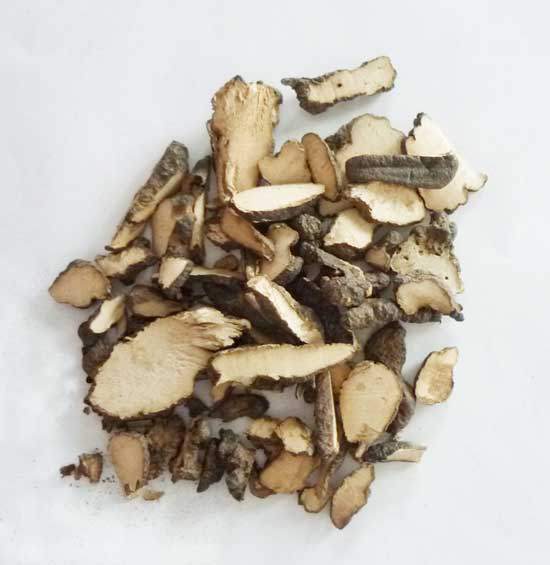
Zhu Ling (Grifola). The sclerotium of Polyporus umbellatus (Pers.) Fries. of family Polyporaceae
Ze Xie (Oriental Waterplantain Rhizome)
Ze Xie (Oriental Waterplantain Rhizome): promote urination and drain dampness, purge heat.
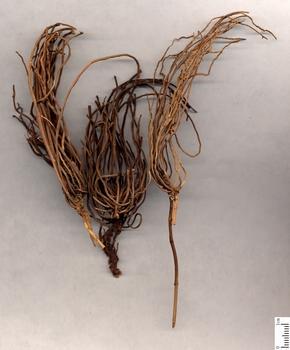 Xu Chang Qing: Chinese Herb Guide
Xu Chang Qing: stop cough and relieve pain, promote diuresis and resolve swelling, activate blood and remove toxicity.
Something this article did not cover?
Ask us directly. We reply within two days, and good questions become public articles.
Ask a question →