
Cold-Phlegm-Warming and Resolving Herbs
Bai Qian (Glaucescent Swallowwort Rhizome)
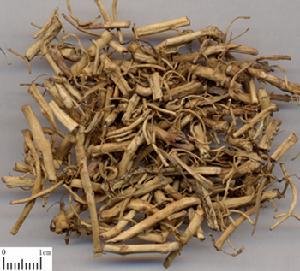
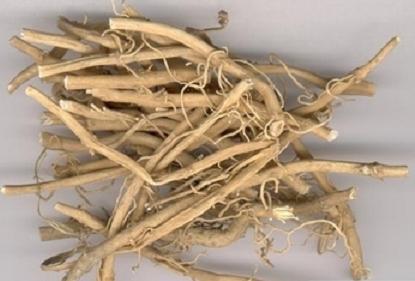
Name
Bai Qian (Rhizoma Cynanchi Stauntonii), from Ming Yi Bie Lu (Miscellaneous Records of Famous Physicians)
Source and quality
The dry root tuber or root of the perennial herbaceous plants Cynanchum stauntonii (Decne.) Schltr. ex Levl. or C. glaucescens (Decne.) Hand.-Mazz. of the family Metaplexis. It is produced in Zhejiang, Anhui and Jiangsu provinces, and collected in autumn.
It has a slight odor and a slightly sweet taste. The best grade is thick. It is used raw or processed with honey.
Nature and action
Pungent, bitter and slightly warm. It enters the lung meridian.
It directs qi downward and eliminates phlegm, relieves cough and relieves dyspnea.
Indications
Cough with profuse phlegm, and dyspnea
This herb is slightly warm in nature and is neither dry nor drastic. It excels at directing lung qi downward and eliminating phlegm, which makes it a commonly used herb for treating cough and dyspnea: once qi is directed downward and phlegm resolved, cough, dyspnea and fullness in the chest disappear.
It may be used for cough and dyspnea arising from external or internal invasion, of cold or heat, and of new or long-standing pattern, and especially for cold-phlegm obstruction of the lung with lung qi failing to descend.
- For cough and dyspnea due to cold-phlegm, it is usually combined with herbs that warm and resolve cold-phlegm, such as Bai Jie Zi, Ban Xia and Su Zi.
- For cough with unsmooth expectoration due to invasion by wind-cold, it is combined with herbs that ventilate the lung and release the exterior, such as Jing Jie and Jie Geng in Zhisou San from Yi Xue Xin Wu.
- For cough and dyspnea due to accumulation of pathogenic heat in the lung, it is combined with herbs that clear and purge lung heat, such as Sang Bai Pi and Ting Li Zi in Bai Qian Wan from Sheng Ji Zong Lu.
- For impairment of lung qi and yin due to long-standing illness, it is combined with herbs that replenish qi and moisten the lung, such as Huang Qi and Bei Sha Shen.
Dosage and administration
Decoct 3~10 g, or use it in pills and powder. Bai Qian processed with honey is mild in nature and is used mainly for lung yin deficiency with reversed flow of qi and a non-productive cough.
Cautions
This herb stimulates the stomach mucosa, so use it with caution in anyone with stomach disease or a tendency to bleeding. Use with caution in cough and dyspnea due to lung deficiency.
Sources and further reading
We cite classical materia medica and modern reference works. This article is health education, not medical advice.
- Shennong Bencao Jing (The Divine Farmer's Materia Medica), Han dynasty.
- Bencao Gangmu (Compendium of Materia Medica), Li Shizhen, 1578.
- Chinese Pharmacopoeia, current edition — identity, quality and safety monographs.
- NCCIH and WHO reference material on traditional medicine safety.
Spotted an error or a better source? Tell us — corrections are logged on our editorial policy page.
Did this article help you?
Your answer shapes what gets rewritten next.
Keep readingRelated entries
Willowleaf Swallowwort Rhizome (Glaucescent Swallowwort Rhizome)
Bai Qian: direct qi downward and eliminate phlegm, relieve cough and relieve wheezing.
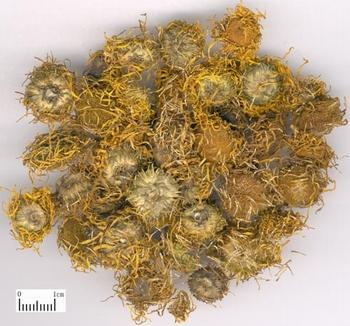 Xuan Fu Hua (Inula Flower)
Xuan Fu Hua: direct qi downward and resolve phlegm, check adverse flow of qi and stop vomiting.
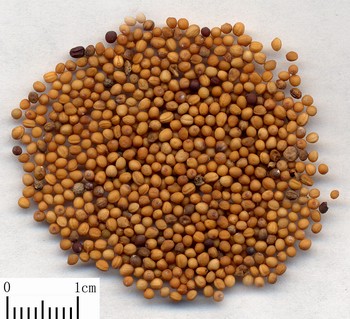 Bai Jie Zi (White Mustard Seed)
Bai Jie Zi: warm lung and dispel phlegm, promote qi flow and dissipate nodulation, resolve swelling and alleviate pain.
Bai Qian (Willowleaf Swallowwort Rhizome)
Bai Qian (Willowleaf Swallowwort Rhizome): direct qi downward and eliminate phlegm, relieve cough and relieve wheezing.
Something this article did not cover?
Ask us directly. We reply within two days, and good questions become public articles.
Ask a question →