
Wind-Cold-Dispersing Herbs
Qiang Huo (Incised notopterygium rhizome and root)
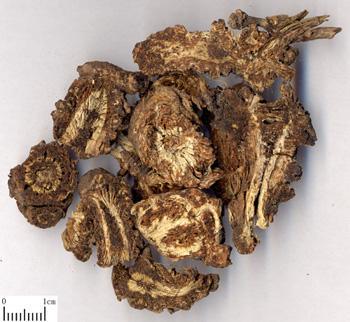
Name
Qiang Huo (Rhizoma seu Radix Notopterygii)——Shen Nong Ben Cao Jing (Shen Nong’s Herbal)
The Processing of 羌活
Origin
The dry rhizome and root of perennial herbaceous plant Notopterygium incisum Ting. ex H. T. Chang or N. forbesii Boiss. of family Umbelli ferae.
Location
Notopterygium incisum Ting. ex H. T. Chang primarily grows in Sichuan, Yunnan, Qinghai provinces in China; N. forbesii Boiss. primarily grows in Sichuan, Qinghai, Shanxi,Henan provinces in China.
Harvest
Collected in spring and autumn.
The real smell and taste
Fragrant smell, slightly bitter and pungent taste.
Best quality
Big strip with dark brown skin, many red spots on the cross section and strong fragrance.
Processing
Sliced and unprocessed.
The Effect of 羌活
Property
Pungent, bitter, warm; lung and bladder meridians entered.
Actions
Release exterior and disperse cold, expel wind-damp and alleviate pain.
Indications
A. Wind-cold exterior syndrome
This herb has strong actions of releasing exterior and dispersing cold, expelling wind-damp as well as alleviating pain. It is indicated for the cases with more severe syndrome of external wind-cold contraction with concurrent dampness, which is manifested as aversion to cold and fever, absence of sweat, headache, painful and stiff nape, aching pain of body and limbs. It is usually conbined with herbs that release wind-cold and expel dampness and alleviate pain. For instance it is combined with Fang Feng, Chuan Xiong in Jiu Wei Qiang Huo Tang from Ci Shi Nan Zhi (Such Inscrutable Matter). It is combined with Du Huo, Gao Ben, Fang Feng in Qiang Huo Sheng Shi Tang from Nei Wai Shang Bian Huo Lun (Treatise on Confuse Differentiation of Internal and External Injury).
B. Wind-cold-damp arthralgia
Being pungent and warm with the strong actions of expelling wind-damp and alleviating pain, it is also used for wind-cold-damp arthralgia manifested as body and limbs pain. Because it enters taiyang bladder meridian of foot and is good at alleviating headache and pain of shoulder and back, it especially is suitable for treating wind-cold arthralgia and body and limbs pain in upper half-length. It is usually combined with wind-damp-expelling herbs and blood-activating and pain-alleviating herbs. For instance it is combined with Fang Feng, Dang Gui in Juan Bi Tang from Bai Yi Xuan Fang (Precisely-selected Prescriptions).
For headache due to invasion of wind-cold or wind-damp pathogens, it is usually combined with wind-expelling and pain-alleviating herbs, such as Chuan Xiong, Bai Zhi and Gao Ben.
Dosage and Administrations
Decoct 3~10g.
Cautions
It should be used with cautions for blood deficiency because of its strong pungent, fragrant, warm and dry property. It is not appropriate for weakness of spleen and stomach because large dose of this herb induces vomiting.
Sources and further reading
We cite classical materia medica and modern reference works. This article is health education, not medical advice.
- Shennong Bencao Jing (The Divine Farmer's Materia Medica), Han dynasty.
- Bencao Gangmu (Compendium of Materia Medica), Li Shizhen, 1578.
- Chinese Pharmacopoeia, current edition — identity, quality and safety monographs.
- NCCIH and WHO reference material on traditional medicine safety.
Spotted an error or a better source? Tell us — corrections are logged on our editorial policy page.
Did this article help you?
Your answer shapes what gets rewritten next.
Keep readingRelated entries
Qiang Huo (Incised notopterygium rhizome and root)
Qiang Huo: release exterior and disperse cold, expel wind-damp and alleviate pain.
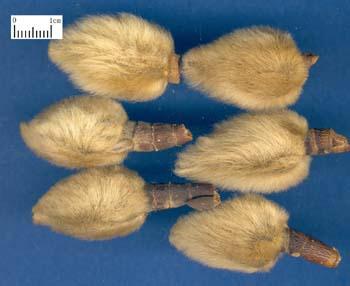 Xin Yi (Biond Magnolia Flower)
Xin Yi (Flos Magnoliae). Bud of magnoliaceae arbors including Magnolia biondii pamp, M. denudata Desr. and M
 Du Heng: Chinese Herb Guide
Du Heng: dispel wind and dissipate cold, alleviate pain, eliminate phlegm and relieve cough.
 Common stelmatocrypton herb (Stem of Common Stelmatocrypton)
Sheng Teng (Stem of Common Stelmatocrypton) Sources The drug is the dried entire plant of Stelmatocrypton khasianum (Benth.) H. Baill
Something this article did not cover?
Ask us directly. We reply within two days, and good questions become public articles.
Ask a question →