
Bai Bu (Japanese Stemona Root)
Bai Bu (Japanese Stemona Root) moistens the lung and stops cough, and kills parasites. Stir-baked with honey it is especially good for chronic cough of deficiency.
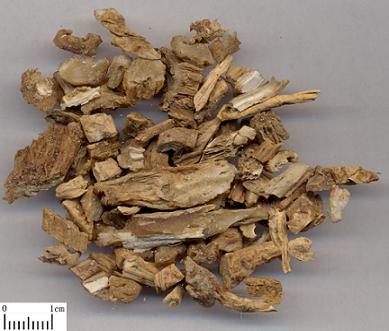
Name
Bai Bu (Radix Stemonae), from Ming Yi Bie Lu (Miscellaneous Records of Famous Physicians)
Source and quality
The dry root tuber of the perennial herbaceous plants Stemona sessilifolia (Miq.) Miq., Stemona japonica (Bl.) Miq. or Stemona tuberosa Lour. of the family Stemonaceae. It is produced in east China, central-south and south China, and collected in spring or autumn. The fibrous roots are removed, the root is cleaned and then blanched briefly in boiling water or steamed thoroughly.
It has a slight odor. Stemona sessilifolia tastes bitter and sweet, while Stemona japonica and Stemona tuberosa taste bitter.
The best grade is robust, moist, firm and white. It is dried in the sun and sliced, and used raw or stir-baked with honey.
Nature and action
Bitter, sweet and slightly warm. It enters the lung meridian.
It moistens the lung and stops cough, and it kills parasites.
Indications
Moistening the lung to stop cough, for both acute and chronic cough
It is good at directing qi downward to stop the cough, and it also moistens the lung after being stir-baked with honey. It is indicated for cough of every kind, whether from external contraction or internal injury, of cold or heat, or of deficiency or excess, and especially for the chronic deficiency pattern.
- For cough due to wind-cold, it is often combined with herbs that ventilate the lung and resolve phlegm to stop the cough, such as Jing Jie, Jie Geng and Zi Wan in Zhisou San from Yi Xue Xin Wu.
- For cough due to wind-heat invading the lung, it is combined with herbs that release the exterior and herbs that clear the lung and stop the cough.
- For cough with phlegm due to cold in the lung, it is combined with herbs that warm the lung and resolve phlegm, reinforcing the actions of ventilating the lung and directing qi downward to stop the cough, as in Bai Bu Wan.
- For cough with bloody sputum due to lung yin deficiency and pulmonary phthisis, it is usually combined with herbs that nourish yin, moisten the lung and stop the cough, such as E Jiao, Chuan Bei Mu and Mai Dong.
- For whooping cough with paroxysms, spasmodic cough and a long course, it is combined with Mai Dong and Gua Lou to strengthen the action of moistening the lung and stopping the cough.
Pinworm and trichomonas vaginalis
It is good at killing parasites.
- For pinworm it is used mostly externally; for instance it can be decocted into a thick juice for use as a retention enema before sleep.
- For trichomonas vaginitis it is used on its own or combined with herbs that kill parasites and relieve itching, applied as a sitz bath or a wash, such as She Chuang Zi and Ku Shen.
Dosage and administration
Decoct 3~10 g. Take a proper dose for external application: decoct it for washing, or use it to make medicated wine, or grind it into a powder.
Stir-baked with honey, it is good at treating chronic cough of deficiency, because that method increases its ability to moisten the lung and stop the cough.
Did this article help you?
Your answer directly shapes how this article gets rewritten. Several sections on this site exist because readers asked for them.
Keep readingRelated for you
Bai Bu (Japanese Stemona Root)
Name Bai Bu (Radix Stemonae) — Mingyi Bielu Source and quality Plant The dry root tuber of perennial Stemona sessili folia (Miq.) Miq., Stemona japonica (BI.) Miq.
Tuber Stemona Root (Japanese Stemona Root)
Name Bai Bu (Radix Stemonae) — Mingyi Bielu Source and quality Plant The dry root tuber of perennial Stemona sessili folia (Miq.) Miq., Stemona japonica (BI.) Miq.
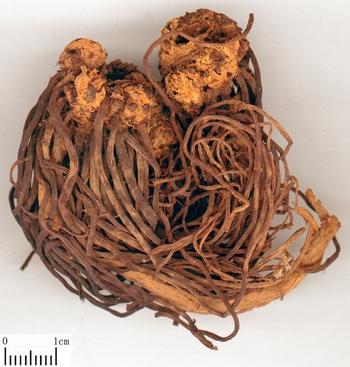 Zi Wan
Name Zi Wan (Radix Asteris) — Shennong Bencao Jing Source and quality Plant The dry root and Rhizoma of perennial Aster tataricus L. f. of family Asteraceae.
Zi Wan
Name Zi Wan (Radix Asteris) — Shennong Bencao Jing Source and quality Plant The dry root and Rhizoma of perennial Aster tataricus L. f. of family Asteraceae.
Something this article didn't cover?
Ask us directly — we reply within 2 days. Great questions become public articles.
Ask a question →