
Zi Wan
Name Zi Wan (Radix Asteris) — Shennong Bencao Jing Source and quality Plant The dry root and Rhizoma of perennial Aster tataricus L. f. of family Asteraceae.
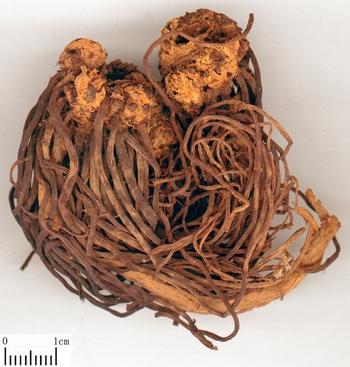
Naming
Zi Wan (Radix Asteris)——Shen Nong Ben Cao Jing (Shen Nong’s Herbal)
The Processing of Zi Wan
Origin
The dry root and Rhizoma of perennial herbaceous plant Aster tataricus L. f. of family Compositae.
Location
Hebei, Anhui and Heilongjiang provinces and so on in China.
Harvest
Collected in spring and autumn.
The actual smell and taste
Lightly fragrant smell, sweet and slightly bitter taste.
Best quality
Long, violet, soft and elastic, without stem and sprout.
Processing
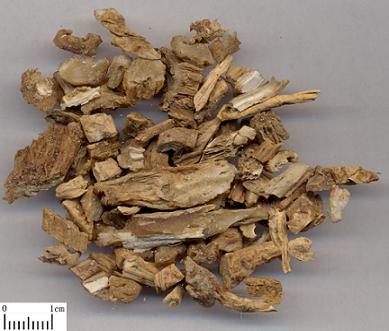
Dried in the sun or stir-baked with honey.
The Effect of Zi Wan
Property
Bitter, pungent, sweet, slightly warm; lung meridian entered.
Actions
Moisten lung to resolve phlegm and stop cough.
Indications
Cough with phlegm
It is often used after stir-baked with honey. Being sweet in flavor, it is moistening. Being bitter in flavor, it is purging. It is pungent and warm without dryness. So it is good at directing qi downward also moistening lung to stop cough and resolving phlegm, it is combined with herbs to treat cough with phlegm caused by external contraction or internal injury, or cold and heat, or deficiency and excess syndromes. For cough due to wind-cold with symptoms of persistent cough and dryness phlegm, it is often combined with wind-cold-dispersing herbs and lung-ventilating to resolve phlegm and stop cough herbs, such as Jing Jie and Jie Geng and so on. For cough due to lung heat with symptoms of profuse yellow thick phlegm, it is often combined with heat-clearing and phlegm-resolving herbs, such as Huang Qin and Chuan Bei Mu and so on. For cough due to lung yin deficiency with symptoms of bloody phlegm, it is often combined with E Jiao, Chuan Bei Mu and Zhi Mu and so on, in Wang Hai Zang Zi Wan Tang.
Dosage and Administrations
Decoct 3~10 g. It is mostly stir-baked with honey.
Did this article help you?
Your answer directly shapes how this article gets rewritten. Several sections on this site exist because readers asked for them.
Keep readingRelated for you
 Bai Bu (Japanese Stemona Root)
 moistens the lung and stops cough, and kills parasites. Stir-baked with honey it is especially good for chronic cough of deficiency.
Bai Bu (Japanese Stemona Root)
Name Bai Bu (Radix Stemonae) — Mingyi Bielu Source and quality Plant The dry root tuber of perennial Stemona sessili folia (Miq.) Miq., Stemona japonica (BI.) Miq.
Zi Wan (Tatarian Aster Root)
Name Zi Wan (Radix Asteris) — Shennong Bencao Jing Source and quality Plant The dry root and Rhizoma of perennial Aster tataricus L. f. of family Asteraceae.
Bai Bu (Japanese Stemona Root)
Bai Bu (Japanese Stemona Root) moistens the lung and stops cough, and kills parasites. Stir-baked with honey it is especially good for chronic cough of deficiency.
Bai Bu (Japanese Stemona Root)
Name Bai Bu (Radix Stemonae) — Mingyi Bielu Source and quality Plant The dry root tuber of perennial Stemona sessili folia (Miq.) Miq., Stemona japonica (BI.) Miq.
Zi Wan (Tatarian Aster Root)
Name Zi Wan (Radix Asteris) — Shennong Bencao Jing Source and quality Plant The dry root and Rhizoma of perennial Aster tataricus L. f. of family Asteraceae.
Something this article didn't cover?
Ask us directly — we reply within 2 days. Great questions become public articles.
Ask a question →