
Qi Tonics
Shan Yao (Wingde Yan Rhizome)


Name
Shan Yao (Rhizoma Dioscoreae), from Shen Nong Ben Cao Jing (Shen Nong's Herbal)
Source and quality
The rhizome of the perennial herbaceous trailing plant Dioscorea opposita Thunb. of the family Dioscoreaceae. It is produced mainly in Henan province, where the finest grade, called Huai Shan Yao, comes from; it is also produced in Hebei and Shaanxi provinces. It is plucked in winter after the stalk and leaves have withered.
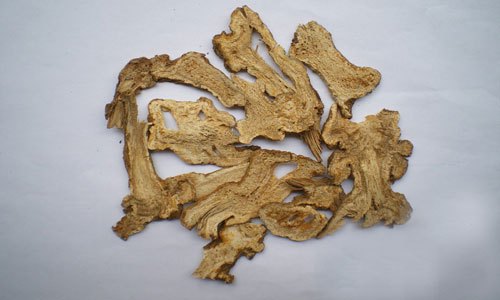
It has a slight taste and is slightly sour. The best grade is coarse and firm, rich in powder, spotlessly white, with a white cross section, and is sticky when chewed.
It is sliced thickly and used raw, or stir-baked with bran.
Nature and action
Sweet and neutral. It enters the spleen, lung and kidney meridians.
It tonifies qi, nourishes yin, and tonifies the spleen, lung and kidney.
Indications
Spleen qi deficiency syndromes
It is indicated for poor appetite with loose stool and for diarrhea due to spleen qi deficiency, especially where spleen qi and yin are both deficient, or where there is a need to tonify but the spleen fails to transport because of weakness after illness. This is because it tonifies both qi and yin of the spleen and is astringent in nature. Being neither dry nor greasy, it suits use both as food and as medicine: it may be taken on its own, or used as food over the long term.
In severe cases of qi deficiency it is usually combined with qi and spleen tonics, because its action is mild.
- Ren Shen and Bai Zhu in Shenling Baizhu San from Tai Ping Hui Min He Ji Ju Fang, for poor appetite with loose stool.
- Wandai Tang from Fu Qing Zhu Nv Ke, for leukorrhagia due to down-pouring of damp-turbidity caused by spleen deficiency and failure of transportation.
Lung qi deficiency syndromes
It tonifies both qi and yin of the lung directly, and it tonifies metal (the lung) by tonifying earth (the spleen).
- For cough with scanty sputum or no sputum, shortness of breath and spontaneous sweating due to lung qi and yin deficiency, it is commonly combined with herbs that tonify qi, nourish yin, moisten the lung and relieve cough, such as Dang Shen, Mai Dong and Bai He.
- For cough and dyspnea due to qi and yin deficiency of the lung and kidney, it is combined with herbs that tonify the kidney, astringe the lung, receive qi and relieve dyspnea: Shu Di Huang, Shan Zhu Yu and Wu Wei Zi in Qi Wei Du Qi Wan from Zhang Shi Yi Tong (Zhang's Medical Experience Collection).
Kidney deficiency syndromes
It is indicated for deficiency of the yin, yang and essential qi of the kidney, because it tonifies kidney qi and yin and also has an astringent action. It appears in many famous kidney-tonifying formulas, where it is combined with kidney tonics and astringents.
- For soreness and weakness of the lumbar region and knees, frequent urination, enuresis, seminal emission, premature ejaculation, and thin, watery leukorrhagia due to kidney qi deficiency, it is indicated on its own.
- For emaciation and soreness and limpness of the lumbar region and knees with seminal emission due to kidney yin deficiency, it is used in Liuwei Dihuang Wan from Xiao Er Yao Zheng Zhi Jue, which is famous for tonifying kidney yin, and in Shenqi Wan from Jin Kui Yao Lue, which is famous for tonifying kidney yang.
Diabetes due to deficiency of both qi and yin
It is indicated for diabetes due to deficiency of both qi and yin, because it tonifies the qi of the spleen, lung and kidney as well as their yin.
- In mild diabetes it is decocted on its own and taken instead of tea.
- In severe diabetes it is combined with herbs that tonify qi, nourish yin, clear heat and generate fluids, such as Huang Qi, Tian Hua Fen and Zhi Mu in Yuye Tang from Yi Xue Zhong Zhong Can Xi Lu.
Dosage and administration
Decoct 5~30 g, or 60~250 g in a large dose. Stir-baking it with bran strengthens its spleen-tonifying and diarrhea-relieving action.
Sources and further reading
We cite classical materia medica and modern reference works. This article is health education, not medical advice.
- Shennong Bencao Jing (The Divine Farmer's Materia Medica), Han dynasty.
- Bencao Gangmu (Compendium of Materia Medica), Li Shizhen, 1578.
- Chinese Pharmacopoeia, current edition — identity, quality and safety monographs.
- NCCIH and WHO reference material on traditional medicine safety.
Spotted an error or a better source? Tell us — corrections are logged on our editorial policy page.
Did this article help you?
Your answer shapes what gets rewritten next.
Keep readingRelated entries
Chinese Yam (Wingde Yan Rhizome)
Shan Yao (Rhizoma Dioscoreae). The rhizome of the perennial herbaceous trailing plant Dioscorea opposita Thunb
 Bai Zhu (Largehead Atractylodes Rhizome)
 tonifies spleen qi, dries dampness, promotes urination, checks sweating and prevents abortion. It is the most.
 Bian Dou (Semen Lablab Album)
Bian Dou (White Lablab Bean) Sweet, slightly bitter; spleen and stomach channels. Actions Tonify spleen and eliminate dampness
 Acanthopanax Root (Manyprickle Acanto-Panax Root)
Ci Wu Jia: invigorate the spleen and kidney, tonify qi and induce tranquilization.
Something this article did not cover?
Ask us directly. We reply within two days, and good questions become public articles.
Ask a question →