
Qi Tonics
Xi Yang Shen (American Ginseng)
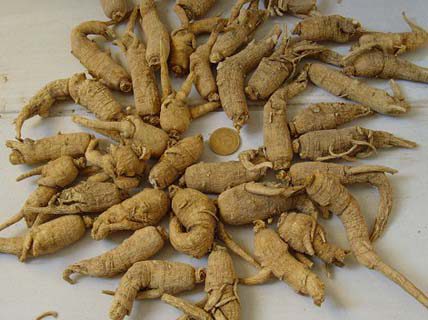
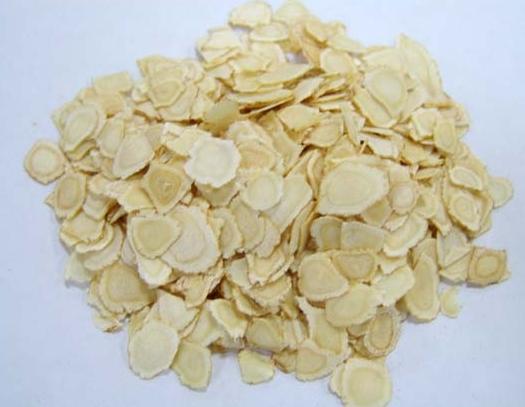
Name
Xi Yang Shen (American Ginseng), recorded in Zeng Ding Ben Cao Bei Yao.
Source and quality
Plant
The root of the perennial Panax quinquefolium L., family Araliaceae.
Where it is grown
Mainly produced in the USA and Canada; also cultivated in Beijing city, Jilin and Liaoning provinces in China.
Harvest
The root is lifted in autumn after three to six years of cultivation, and dried in the sun.
Smell and taste
Slightly fragrant; bitter with a slightly sweet flavor.
Better grade
Even root, firm, with fine close lines on the skin, a white-yellow cross-section, a delicate fragrance and a strong flavor.
Processing
Used unprocessed, sliced, or ground.
Nature and action
Sweet with a slight bitterness, and cool; enters the lung, heart, kidney and spleen channels. Tonifies qi, nourishes yin, clears heat and promotes the generation of body fluid.
When it is used
Combined qi and yin deficiency, and diabetes
Xi Yang Shen resembles Ren Shen, tonifying qi and promoting the generation of body fluid, so it is used for combined qi and yin deficiency and for diabetes.
Its qi-tonifying action is weaker than Ren Shen's, but because of its bitter taste and cool nature it also clears heat, nourishes yin and generates body fluid. It is therefore used mainly where heat has injured qi and yin.
For fever with profuse sweating, thirst, restlessness, lassitude and fatigue, and a weak, rapid pulse, caused by the summer-heat pathogen, it is combined with herbs that clear heat and nourish yin: with Xi Gua Cui Yi, Shi Hu and Zhi Mu in Qing Shu Yi Qi Tang from Wen Re Jing Wei, or with Mai Dong and Wu Wei Zi in Sheng Mai San from Hou Ke Jin Yao. For diabetes showing combined qi and yin deficiency it is combined with herbs that tonify qi, nourish yin and generate fluid, and taken together with Huang Qi, Shan Yao and Tian Hua Fen.
It is also indicated for palpitations, insomnia and dream-disturbed sleep from heart qi and heart yin deficiency, for soreness and weakness of the lumbar region and knees, and for seminal emission and spermatorrhea from kidney qi and kidney yin deficiency.
Combined qi and yin deficiency with effulgent fire, cough with hemoptysis
It does not merely tonify lung qi; it also nourishes lung yin and clears lung heat, so it is used for chronic cough with little phlegm, hemoptysis, dry throat and lassitude from lung qi and lung yin deficiency. It is used alone or together with Bei Sha Shen, Chuan Bei Mu and others.
Dose
Decoction 5~10g. Smashed into powder, 0.5~1 g a time, twice a day. When decocted in herbal tea it should be decocted together with, and mixed into, the other herbs.
Sources and further reading
We cite classical materia medica and modern reference works. This article is health education, not medical advice.
- Shennong Bencao Jing (The Divine Farmer's Materia Medica), Han dynasty.
- Bencao Gangmu (Compendium of Materia Medica), Li Shizhen, 1578.
- Chinese Pharmacopoeia, current edition — identity, quality and safety monographs.
- NCCIH and WHO reference material on traditional medicine safety.
Spotted an error or a better source? Tell us — corrections are logged on our editorial policy page.
Did this article help you?
Your answer shapes what gets rewritten next.
Keep readingRelated entries
Xi Yang Shen: Chinese Herb Guide
Xi Yang Shen: tonify qi, nourish yin, clear heat and promote the generation of body fluid.
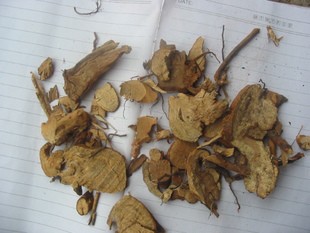 Jin Lv Mei (Radix Hamamelis)
Jin Lv Mei: it is used to clear away toxic heat; for the treatment of overstrain, severe sores.
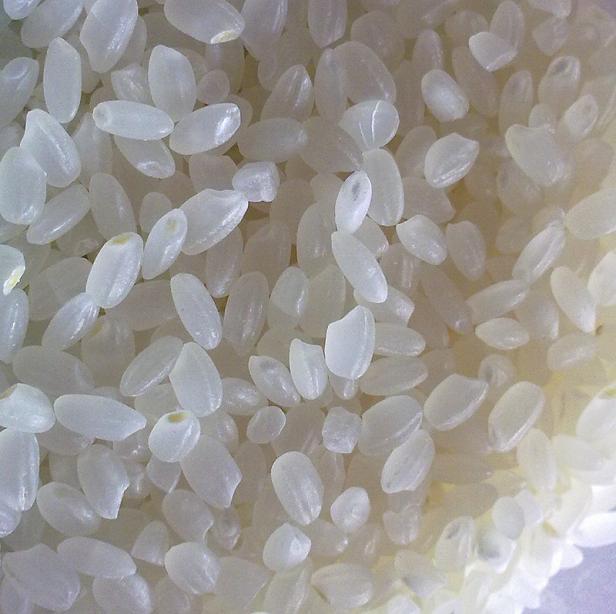 Jing Mi: Chinese Herb Guide
Jing Mi: tonify qi and strengthen the spleen, relieve restlessness, arrest diarrhea.
Rice: Chinese Herb Guide
##Name Jing Mi (Rice) Sweet, neutral; lung and spleen channels. Actions Tonify qi and strengthen the spleen, relieve restlessness, arrest diarrhea
Something this article did not cover?
Ask us directly. We reply within two days, and good questions become public articles.
Ask a question →