
Blood Tonics
Bai Shao (White Paeony Root)
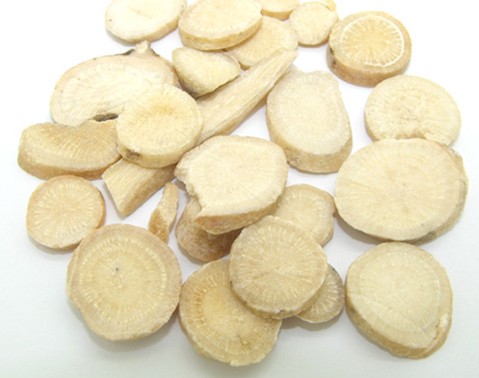
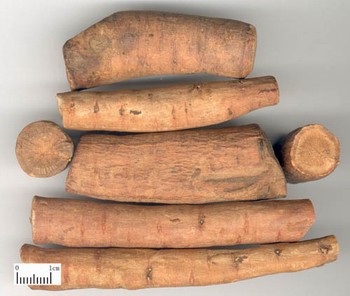
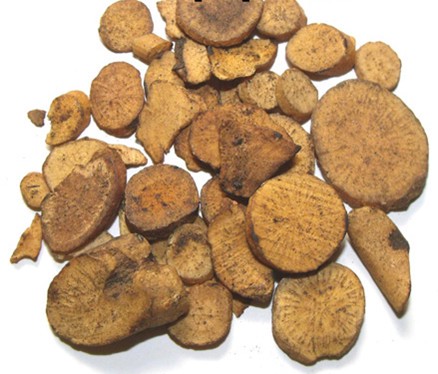
Name
Bai Shao (Radix Paeoniae Alba), from Shen Nong Ben Cao Jing (Shen Nong's Herbal)
Source and quality
The root of the perennial herbaceous plant Paeonia lactiflora Pall. of the family Buttercup. It is produced in Zhejiang, Anhui and Sichuan provinces, and is plucked in summer and autumn, peeled, boiled and dried in the sun.
It has a slight odor and is slightly bitter and sour. The best grade has a coarse, straight, long root with a bright, clean outer surface, firm and rich in powder.
It is used raw or stir-baked.
Nature and action
Bitter, sour, sweet and slightly cold. It enters the spleen and liver meridians.
It tonifies blood, astringes yin and checks sweating, emollients the liver and relieves pain, and calms and suppresses liver yang.
Indications
Blood deficiency syndrome
It is a common herb for regulating menstruation, and it is especially indicated for irregular menstruation of the blood deficiency with heat pattern, because it is cool in nature and skilled at clearing deficiency heat from the blood system.
- For irregular menstruation of blood deficiency with heat, it is combined with herbs that nourish blood and clear heat: Si Wu Tang with Huang Lian and Huang Qin added gives Qin Lian Si Wu Tang from Yi Zong Jin Jian.
- For irregular menstruation of blood deficiency with liver depression, it is combined with herbs that soothe the liver and nourish blood, such as Chai Hu and Dang Gui in Xiaoyao San from Tai Ping Hui Min He Ji Ju Fang.
- For metrorrhagia and metrostaxis with dark-red blood, and vexing heat in the chest due to yin deficiency with effulgent heat, it is combined with herbs that nourish yin and clear heat, such as Gui Jia, Huang Qin and Huang Bo in Gujing Wan from Yi Xue Ru Men.
Sweating due to deficiency
It astringes yin and checks sweating.
- For night sweating due to yin deficiency, it is combined with herbs that nourish yin and check sweating, such as Sheng Di Huang and Mu Li.
- For spontaneous sweating due to superficial deficiency caused by disharmony between the yin and the defensive system, it is used with Gui Zhi in Guizhi Tang from Shang Han Lun.
Hypochondriac pain, abdominal pain and muscular contracture of the four limbs
This herb is particularly good at relieving pain by emollienting the liver, and it is a commonly used herb for all of the above pains caused by deficiency of liver blood and tendon dystrophy. It is often applied together with Gan Cao so that the two reinforce each other, as in Shaoyao Gancao Tang from Shang Han Lun. Variations of this formula are often used to treat contracture occurring in the course of many diseases.
Hyperactivity of liver yang
This herb can subdue liver yang and clear liver heat. It is applied to treat dizziness and vertigo, flushed face, congestion of the conjunctiva and irritability due to hyperactivity. It is often combined with herbs that subdue hyperactive liver yang, clear heat and replenish yin, such as Dai Zhe Shi and Sheng Di Huang, as recorded in Jian Ling Tang in Yi Xue Zhong Zhong Can Xi Lu.
Dosage and administration
Decoct 10~30 g, or 15~30 g in a large dose. Use the raw herb to pacify the liver and astringe yin; stir-bake it, or stir-bake it with alcohol, to nourish blood and regulate menstruation.
Sources and further reading
We cite classical materia medica and modern reference works. This article is health education, not medical advice.
- Shennong Bencao Jing (The Divine Farmer's Materia Medica), Han dynasty.
- Bencao Gangmu (Compendium of Materia Medica), Li Shizhen, 1578.
- Chinese Pharmacopoeia, current edition — identity, quality and safety monographs.
- NCCIH and WHO reference material on traditional medicine safety.
Spotted an error or a better source? Tell us — corrections are logged on our editorial policy page.
Did this article help you?
Your answer shapes what gets rewritten next.
Keep readingRelated entries
Bai Shao: Chinese Herb Guide
Bai Shao: tonify blood, astringe yin to check sweating, emolliate liver to alleviate pain, calm and suppress liver yang.
 Shou Wu (Tuber Fleeceflower Root)
He Shou Wu (Tuber Fleeceflower Root) tonifies blood, supplements essence, checks malaria, relieves toxicity and moistens the intestines. Stir-baked for.
Bai Shao (White Paeony Root)
Bai Shao (White Paeony Root) tonifies blood, astringes yin and checks sweating, emollients the liver and relieves pain, and calms and suppresses liver yang..
 Niu Rou: Chinese Herb Guide
Niu Rou: tonify the spleen and stomach, replenish qi and blood, strengthen the tendons and bones.
Something this article did not cover?
Ask us directly. We reply within two days, and good questions become public articles.
Ask a question →