
Wind-Cold-Dispersing Herbs
Jing Jie (Schizonepeta): Uses, Charred Form and Dose


Name
Jing Jie (schizonepeta, Herba Schizonepetae), recorded in the Shennong Bencao Jing. The flowering spikes are Jing Jie Sui.
Source and quality
Plant
The aerial parts of the annual Schizonepeta tenuifolia Briq., family Lamiaceae (Labiatae).
Where it is grown
Mainly cultivated in Jiangsu, Zhejiang and Henan.
Harvest
Summer and autumn, when the green flower spikes are well formed.
Smell and taste
Aromatic; slightly astringent, acrid and cooling on the tongue.
Better grade
Light yellowish-green, long firm spikes, strong smell.
Processing
Used raw, or stir-baked to charcoal.
Nature and action
Acrid, slightly warm; enters lung and liver. Dispels wind and releases the exterior; promotes the surfacing of rashes; eases itching. The charred herb is used to stop bleeding.
When it is used
Exterior patterns
Jing Jie is mild enough to appear in both wind-cold and wind-heat formulas, and in cases where cold versus heat is not yet obvious. For wind-cold with chills, fever, headache and no sweat, it is paired with Fang Feng and Qiang Huo (Jing Fang Bai Du San). For wind-heat with fever and headache, it is paired with Jin Yin Hua, Bo He and Lian Qiao (Yin Qiao San).
Itching
For wind locked on the surface with itchy skin, it is often used with Chan Tui and Fang Feng.
Bleeding (charred Jing Jie)
Charred Jing Jie is used for vomiting blood, nosebleed, blood in the stool, and uterine bleeding in the old categories. For heat-driven bleeding it is combined with Sheng Di Huang and Bai Mao Gen; for stool bleeding or hemorrhoidal bleeding with Di Yu and Huai Hua; for uterine bleeding with Qian Cao and Guan Zhong. That is formula logic, not a reason to charcoal-burn a herb at home for a hemorrhage.
Dose
Decoction 5–10 g. Do not cook it for a long time. Use the raw herb to release the exterior and ease itching; use the charred herb when the aim is to stop bleeding.
Sources and further reading
We cite classical materia medica and modern reference works. This article is health education, not medical advice.
- Shennong Bencao Jing (The Divine Farmer's Materia Medica), Han dynasty.
- Bencao Gangmu (Compendium of Materia Medica), Li Shizhen, 1578.
- Chinese Pharmacopoeia, current edition — identity, quality and safety monographs.
- NCCIH and WHO reference material on traditional medicine safety.
Spotted an error or a better source? Tell us — corrections are logged on our editorial policy page.
Did this article help you?
Your answer shapes what gets rewritten next.
Keep readingRelated entries
 Fang Feng (Siler Root)
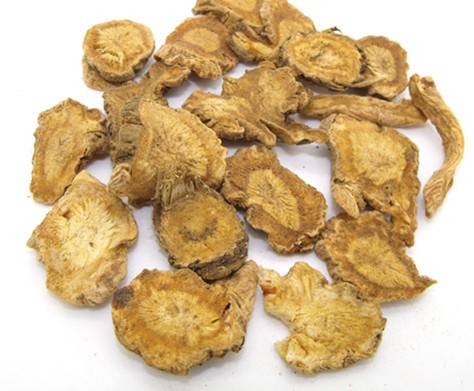
Fang Feng (siler root, Radix Saposhnikoviae ), recorded in the Shennong Bencao Jing
 Cong Ye (Folium Allii Fistulosi)
Fistular Onion Leaf: expel wind and induce sweating, remove toxicity and resolve swelling.
 Yuan Sui Zi (Coriander Fruit)
: promote the eruption of poxes, stimulate the appetite.
 Ma Huang (Ephedra): Uses, Forms, Dose and Safety
Ma Huang (ephedra stem, Herba Ephedrae ), recorded in the Shennong Bencao Jing . The herbaceous stems of Ephedra sinica Stapf, E
Something this article did not cover?
Ask us directly. We reply within two days, and good questions become public articles.
Ask a question →