
Wind-Cold-Dispersing Herbs
Xiang Ru (Mosla): Summer Cold, Damp and Edema


Name
Xiang Ru (mosla, Herba Moslae), recorded in the Mingyi Bielu.
Source and quality
Plant
The aerial parts of Mosla chinensis Maxim., including the cultivated form often sold as Jiang Xiang Ru, family Lamiaceae.
Where it is grown
A well-known producing area is Yifeng County, Jiangxi, with large output and a reputation for quality.
Harvest
Cut when stems and leaves are at their full growth.
Smell and taste
Strongly aromatic; cooling and slightly acrid.
Better grade
Dense fragrance; fine branches with many flower spikes.
Processing
Sliced; used unprocessed.
Nature and action
Acrid, slightly warm; enters lung, spleen, stomach and gallbladder. Disperses wind-cold; transforms damp and harmonizes the middle; promotes urination to ease edema.
When it is used
Wind-cold on the exterior with damp in the middle
Xiang Ru can sweat a wind-cold exterior and also move damp in the spleen and stomach. The picture is chills, fever, heavy head and body, no sweat, epigastric fullness, poor appetite, a greasy tongue coating, sometimes nausea or diarrhea. It is often combined with Hou Po and Bian Dou (Xiang Ru San). That pattern is common after iced drinks in hot weather, which is why older physicians called Xiang Ru “the exterior herb of summer.” For a plain wind-cold it can sit with other cold-dispersing herbs; for middle damp, Cang Zhu or Huo Xiang may be added.
Edema with an exterior pattern
It can sweat damp from the surface and also spread lung qi to open the waterways, so it is used for edema that still has exterior signs — alone in simple cases, or with other water-moving herbs.
Dose
Decoction 6–15 g. To induce a sweat, keep the dose moderate; avoid a huge dose boiled for a long time, and drink it warm. For edema, a denser decoction is the traditional way to move water.
Sources and further reading
We cite classical materia medica and modern reference works. This article is health education, not medical advice.
- Shennong Bencao Jing (The Divine Farmer's Materia Medica), Han dynasty.
- Bencao Gangmu (Compendium of Materia Medica), Li Shizhen, 1578.
- Chinese Pharmacopoeia, current edition — identity, quality and safety monographs.
- NCCIH and WHO reference material on traditional medicine safety.
Spotted an error or a better source? Tell us — corrections are logged on our editorial policy page.
Did this article help you?
Your answer shapes what gets rewritten next.
Keep readingRelated entries
 Zi Su Ye (Perilla Leaf) in TCM
Zi Su Ye (Perilla Leaf) disperses wind-cold, promotes the flow of qi and soothes the middle. It suits wind-cold exterior syndrome with qi stagnation. Do not.
 Gui Zhi (Cassiabarktree branchlet)
: induce sweating and release exterior, warm and unblock the meridians, warm and reinforce the yang qi.
 Fresh Ginger (Sheng Jiang)
Sheng Jiang (fresh ginger, Rhizoma Zingiberis Recens ), recorded in the Mingyi Bielu: Acrid, warm; enters lung, spleen and stomach. Disperses wind-cold; warms
 Bai Zhi (Dahurian Angelica): Headache, Nose and Leukorrhea
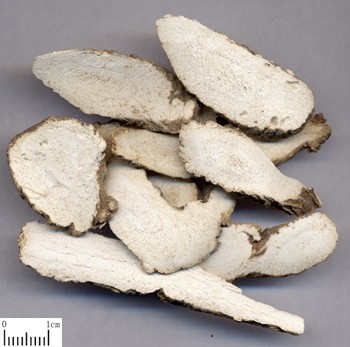
Bai Zhi (dahurian angelica root, Radix Angelicae Dahuricae ), recorded in the Shennong Bencao Jing . The root of Angelica dahurica (Hoffm.) Benth
Something this article did not cover?
Ask us directly. We reply within two days, and good questions become public articles.
Ask a question →