
Wind-Cold-Dispersing Herbs
Bai Zhi (Dahurian Angelica): Headache, Nose and Leukorrhea
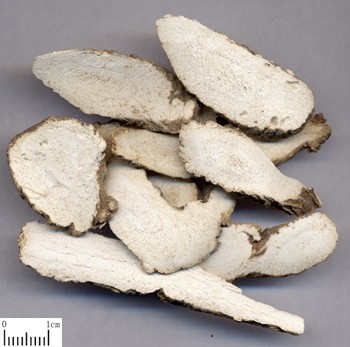
Name
Bai Zhi (dahurian angelica root, Radix Angelicae Dahuricae), recorded in the Shennong Bencao Jing.
Source and quality
Plant
The root of Angelica dahurica (Hoffm.) Benth. & Hook. f. ex Franch. & Sav., or the Taiwan variety often listed as A. dahurica var. formosana, family Apiaceae.
Where it is grown
Henan stock is often sold as Yu Bai Zhi; Hebei as Qi Bai Zhi. Zhejiang, Fujian and Sichuan produce Hang Bai Zhi and Chuan Bai Zhi.
Harvest
Summer and autumn, when the leaves have yellowed.
Smell and taste
Strongly aromatic; acrid, a little bitter.
Better grade
Stout, heavy, powdery roots with a strong smell.
Processing
Sliced; used unprocessed.
Nature and action
Acrid, warm; enters lung, stomach and large intestine. Expels wind and releases the exterior; eases pain; opens the nose; dries dampness and checks leukorrhea.
When it is used
Wind-cold on the exterior
Its sweat is mild; its value is headache and a blocked, runny nose. It is often paired with Qiang Huo, Xi Xin and Chuan Xiong (Jiu Wei Qiang Huo Tang). In a wind-heat pattern it is only an assistant for pain, not the lead herb.
Pain in the yangming zone
It enters the stomach channel, so it is a usual choice for forehead pain, pain around the brow, and toothache. In wind-cold it can appear alone (Du Liang Wan) or with Fang Feng and Chuan Xiong (Chuan Xiong Cha Tiao San). In wind-heat it sits with Bo He and Ju Hua. It can also back up other herbs in bi pain or trauma pain.
Stuffy, runny nose
It both dries damp and helps yangming clear qi reach the nose, so it is used for sinus-type pictures with forehead pain — taken internally, or in the old practice of smelling the powder. Common partners are Cang Er Zi and Xin Yi.
Leukorrhea
Warm and drying, it checks copious discharge. For cold-damp it is paired with Bai Zhu, Shan Yao and Fu Ling; for yellow or red discharge from damp-heat, with Huang Bai and Che Qian Zi — Bai Zhi astringes, the others clear.
It also appears for wind-type itch, and in early sores to help swellings move; once pus has formed it can assist qi- and blood-tonics to expel pus.
Dose
Decoction 3–10 g. External use as appropriate.
Cautions
Use carefully in yin deficiency with blood heat: the herb is acrid, aromatic, warm and dry.
Sources and further reading
We cite classical materia medica and modern reference works. This article is health education, not medical advice.
- Shennong Bencao Jing (The Divine Farmer's Materia Medica), Han dynasty.
- Bencao Gangmu (Compendium of Materia Medica), Li Shizhen, 1578.
- Chinese Pharmacopoeia, current edition — identity, quality and safety monographs.
- NCCIH and WHO reference material on traditional medicine safety.
Spotted an error or a better source? Tell us — corrections are logged on our editorial policy page.
Did this article help you?
Your answer shapes what gets rewritten next.
Keep readingRelated entries
 Fresh Ginger (Sheng Jiang)
Sheng Jiang (fresh ginger, Rhizoma Zingiberis Recens ), recorded in the Mingyi Bielu: Acrid, warm; enters lung, spleen and stomach. Disperses wind-cold; warms
 Xiang Ru (Mosla): Summer Cold, Damp and Edema
Xiang Ru (mosla, Herba Moslae ), recorded in the Mingyi Bielu . The aerial parts of Mosla chinensis Maxim., including the cultivated form often sold a
 Cang Er Zi (Xanthium Fruit)
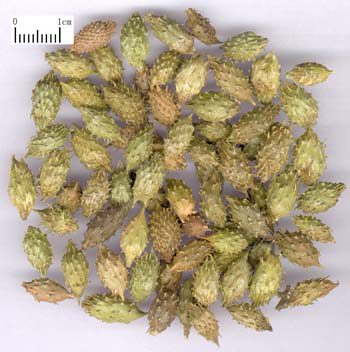
Cang Er Zi (xanthium fruit, Fructus Xanthii ), recorded in the Shennong Bencao Jing: Acrid, bitter, warm, toxic ; enters the lung. Disperses wind-cold; opens
 Xin Yi (Biond Magnolia Flower)
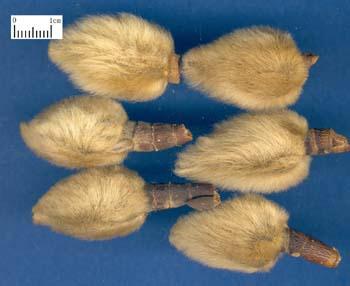
Xin Yi (Flos Magnoliae). Bud of magnoliaceae arbors including Magnolia biondii pamp, M. denudata Desr. and M
Something this article did not cover?
Ask us directly. We reply within two days, and good questions become public articles.
Ask a question →